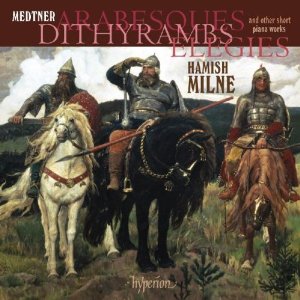
The title is already intriguing; enough to send you running to the dictionary to find out what a dithyramb is. Nikolai Medtner’s three examples are fun to listen to, the second finishing with a flamboyant coda. Born in Moscow in 1880, poor Medtner eventually pitched up in a Golders Green semi, dying there in 1951. He had his champions – Rachmaninov respected him highly, and Horowitz believed that he was “a wonderful composer”. His music is lyrical, highly melodic and beautifully constructed. Medtner’s undeserved neglect must stem from his sheer unfashionability. In Philip Pullman’s words, “He went on calmly writing music in an idiom as out-of-date as his clothes, completely untouched not just by fashion but by common sense as well.”
Hamish Milne’s latest Medtner anthology is ordered chronologically, with 38 short pieces spread across two discs. At times it’s as if you’re listening to a sequence of elegant short stories, the best of them incredibly vivid. Works such as the Op23 Vier lyrische Fragmente speak with poignant eloquence, while the tiny Scherzo infernale provokes smiles. The Zwei Elegien, Medtner’s final solo piano utterance, are bleakly impressive. You can lose yourself for hours in this music, and Hamish Milne’s performances are immaculate; anyone searching for a neglected late-romantic composer to swoon over should start here. Good notes too.

Martin Shaw was born in Camberwell in 1875 and died in 1958. He was a prolific songwriter who edited the Oxford Book of Carols. He was responsible for arranging the hymn "Morning Has Broken", and composed a work for Britten’s first Aldeburgh Festival in 1948. Cautious listeners worried about another underwhelming British genius rescued from obscurity need not panic; Delphian’s anthology suggests that Shaw's music is worthy of resuscitation.
This collection of 36 songs is impressively consistent in terms of quality. Tenor Andrew Kennedy praises Shaw’s compositional fluency, and George Odam’s sleevenote comments on his “simplicity of purpose” - Shaw’s best numbers fuse consistently catchy melodies with elegant, unfussy piano backing. I was bowled over by The Conjuration, a magical rendering of a Chinese poem. Andrew Kennedy’s tenor line hovers over a haunting, pentatonic piano part. The Airmen sets an iffy poem celebrating the Battle of Britain, with a growling piano part which makes the song much more than a jingoistic tub-thump. Sit yourself down with the CD booklet, follow the texts and marvel at Shaw’s understated artistry. Iain Burnside’s effortless pianism holds the disc together. All three singers impress, and Delphian’s production values are handsome.
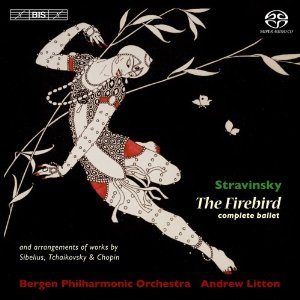
Decent versions of Stravinsky’s complete Firebird are easy to find. My favourites include a crystalline LSO/Antal Dorati version from the late 1950s and François-Xavier Roth’s recent period-instrument recording. Stravinsky’s 1945 suite presents us with the score’s highlights in their most approachable form. But on this BIS disc Andrew Litton gives us 47 minutes of the original ballet score. This is a pretty handsome performance in every respect, rendered unmissable by spectacular, realistic sound. Stravinsky anoraks will happily note the extra details audible in the “wastefully large” orchestra – the offstage trumpet calls are effective, as are the same players’ onstage long notes in the brassy final scene. Nothing to complain about at all, but my advice would be to head straight for the couplings.
This is not to underplay the excellence of the main attraction, like someone who’s just eaten at a flash restaurant banging on about the quality of the cheese and biscuits. We get Stravinsky’s tender, unexpected arrangement of Sibelius’s Canzonetta, and two brilliant, Stravinskyesque orchestrations of numbers from Tchaikovsky’s Sleeping Beauty. There are two rare Chopin transcriptions, originally commissioned by Diaghilev in 1909. Best of all is the 51-second Greeting Prelude, an insane, fractured version of Happy Birthday written for the 80th birthday of conductor Pierre Monteux. Litton directs his superb Bergen players with confidence; the miniatures sparkle and the ballet has the right epic sweep.