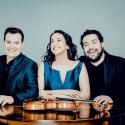
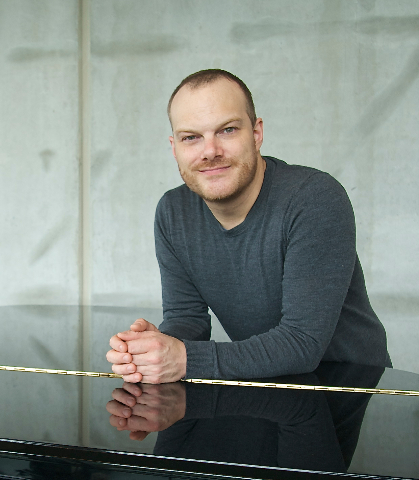
Sonata no 1 – Sonata no 2 – Sonata no 3 – that’s barely a recital programme, it’s just a list. Fortunately, violinist Christian Tetzlaff and pianist Lars Vogt (pictured below by Neda Navae) have good musical reasons for presenting the Brahms violin sonatas in chronological order. The three works are similar in style, but the mood changes subtly from one to the next, and this performance at Wigmore Hall felt like a journey, from the nebulous but lyrical world of the First Sonata through to the more dynamic and dramatic Third.
Tetzlaff and Vogt have a long acquaintance with the Brahms sonatas. They first recorded them together in 2002, and have since made a second recording, released to much acclaim last year. Predictably then, their performance here was technically flawless, with the two players closely aligned in every aspect of interpretation. But there was never any sense of routine, and Tetzlaff’s ability to breathe life into each of Brahms’s songful melodies was matched by Vogt’s subtle harmonic shifts and gently rolling accompaniment textures.
 These were measured readings, carefully paced so that the steady tempos afforded repose rather imposing grandeur. Tetzlaff’s performed each movement of the First Sonata as if it were an unbroken, sinuous melody. There was little sense of architecture, and very little contrast between themes. Even the concluding cadences to each of the movements were downplayed for continuity. The Second Sonata was presented with slightly more rhythmic definition, the piano’s offbeat interjections imposing a greater sense of momentum to the opening movement. Tetzlaff responded by adding slightly edge to his attacks, though still retaining his absolute evenness of tone.
The greater drama of the Third Sonata highlighted subtle contrasts between the two instruments. Tetzlaff’s tone isn’t broad. He plays a modern violin, which projects a sweet but narrow voice. His use of vibrato is reserved, an occasional and carefully applied colouring to an otherwise direct and uncomplicated sonority. Vogt gets on well with the Wigmore Hall Steinway, producing a similarly well-judged tone, but usually tending towards warmth and richness, the contrast with Tetzlaff’s drier tone all the more marked as the dynamics increase.
The four movements of the Third Sonata each highlighted a different quality of the two players’ interaction. Complex rhythms underpin the first movement, but sounded clear and unambiguous here. The slow second movement was again presented by Tetzlaff as a single, uninterrupted line, but more declamatory now, and with Vogt following suit. The scherzo third brings the two instruments into complex rhythmic interaction, but even when Brahms sets one player against the other, they still play as one. And in the rousing finale, the two players finally broke free of their earlier reserve for a propulsive tarantella. The change of pace was welcome, with weighty attacks from both combining with the faster tempo to bring drive and focus. But even here, the primary qualities were evenness of tone – Tetzlaff reaching into the higher registers and proving just as solid there - and unity of intent, the sense of shared conviction driving the music right up to the very last bar of the score.