John Simpson remains the BBC’s longest serving foreign correspondent. Here, he returns to the biggest moment of his career. This personalised retelling of the collapse of the Berlin wall encompasses fond remembrance, factual detail and the confidence of retrospective analysis. And, the big BUT question is addressed: where are we now?
Simpson interviews a crew of historians and journalists who were close to the events. One news cameraman, Mark McCauley, used a hidden camera to record the first protests against the communist regime held in Leipzig. In blurred and blackened images of shouting crowds, McCauley captured the fear and elation that typified the visual images of the era.
Simpson shares the common view that the fall of the Berlin wall was the summation of a long period of “slow decline” of Soviet and communist supremacy. We see this gradual shift in the form of Gorbachev’s election, the opening up of Poland, the Tianenmen square massacre, and more locally, the role of West German media in East Berlin. It is this last issue that is foregrounded as the decisive cause of the fall.
The story is as fascinating as it is absurd. On 9 November 1989, the GDR announced, via TV press conference, that it would gradually relax the travel restrictions for its citizens. The real plan was for a phased introduction of travel permits for specifically assessed people. However, the Politburo spokesman fluffed his lines and said that all restrictions would cease immediately. This was picked up and, crucially, simplified by the West German press, whose own news reports (beamed back into the East), essentially declared an end to the division. East Berliners saw these reports and flocked en masse to the checkpoints. It was fake news, then, that led to the wall coming down.
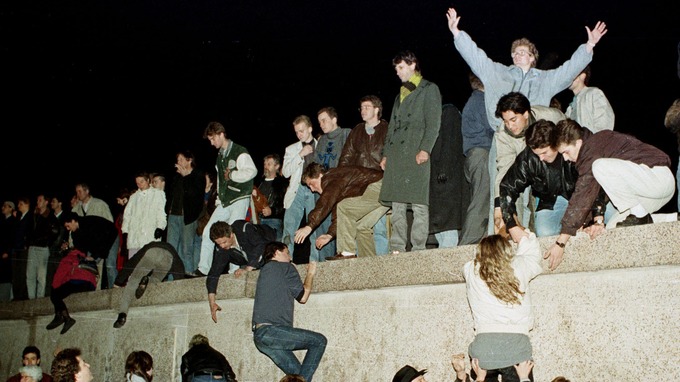 Today, divisions between east and west in Germany seem to be growing. The overwhelming rise of the far-right AfD in eastern states reflects an anger not understood in other areas of the country. Similar divisions, we all know, are appearing worldwide. Late in the program, Simpson mulls over the issue. Was unification a success? How are we to understand its legacy?
The tone quickly turns bittersweet when he considers some current trends: polarisation, cybercrime, Putin and the spread of online misinformation. Simpson strikes a strangely morbid tone when he confesses that things were easier during the Cold War. The binaries of good and bad were sealed, and one’s position was known. This nostalgia, with its jagged mix of affection and remorse, is undoubtedly becoming more common. Yet the moments of dour reflection are necessary because they help us contextualise the specific historical moment. It’s not a hopeful ending, but collective joy is the lasting image.