If you thought that a contemporary drama about forcible repatriation, set in an Immigration removal centre, would be about the plight of those confined in places like the infamous Yarl’s Wood, in Removal Men writers MJ Harding and Jay Miller give us something unexpected.
Instead of the place's inmates, their play concentrates on what it might be like to work in such an environment. Its origins came when Harding – a founder of the band Fat White Family, sharing composer credits with Jonah Brody – became involved with an intervention to prevent the deportation of a detainee at Yarl’s Wood. He found himself wondering just what the experience might feel like for those involved on the other side, the titular ones pushing the process forward. The final work came together in collaboration with Miller, artistic director of The Yard, whose production fits like a glove into the unadorned, warehouse-style atmosphere of this pioneering Hackney venue.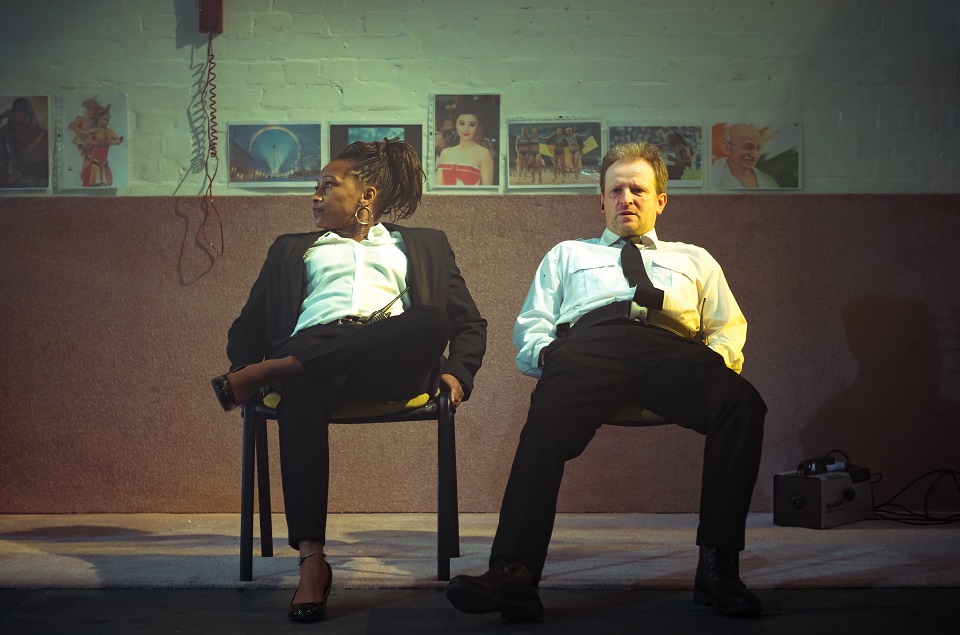 Removal Men is not so much a take-down of the system – although, painstakingly researched in collaboration with people closely caught up in it, it certainly hints at some of the things that are going wrong – as an attempt to convey the stressed experience of doing a job, following bureaucratic guidelines and procedures, that has gone far beyond what any of those concerned can have originally signed up for. Running at around 100 minutes (no interval), it’s a bare – a cast of just three – and breathless ride through sometimes traumatic terrain with a finely tuned sense of the absurd propelling it along.
We first really encounter Mo (Mark Field) and George (Barnaby Power) on a night out in Club Lick (“the second best sex club in the borough of Waltham Forest”). The almost paternal George is a regular, complete with a collection of sexual caprices – his engagement with butt plugs fuels some increasingly farcical ongoing action – and has brought his younger protégé along to cheer him up. Field’s Mo, who comes across initially as something of a well-intentioned dolt, is indeed out of sorts, for reasons that soon become apparent. These two have a well-honed style of casual banter, conveyed in easy-going prose that trips off the tongue. It’s very adept writing, but just when we think we’ve got the hang of their exchanges, the characters drop into song. Complete with Brechtian back-wall projections – and words like “Trauma” and “Utopia” – it takes us out of the immediate context into a world of rough-hewn, sometimes incantatory poetry, a world also of much vulnerability. Calling Removal Men a musical would be stretching it, not least because melody definitely isn’t a priority in these (intentionally) strained solo, duet and trio interludes: instead they amalgamate diverse elements – a bit of Kurt Weill, a dash of music hall, a touch even of singspiel.
The developing action is dominated by two female presences. Off-stage, but like the ubiquitous elephant in the room, there’s Didi, who’s due to be deported back to Lebanon, but has cut her wrists to try and prevent that happening. Beatrice (Clare Perkins) is the exact opposite: the two men’s immediate boss, she could be the definition of in-yer-face. Responsible for keeping the outfit going, most immediately by writing grant applications that overflow with bureaucratic jargonese like “compassionate officer” and “progressive leader”, it’s also her job to get on the phone to the Home Office when things start going wrong. It’s a bravura performance by Perkins (pictured above), whose command of the moment is unfaltering, not least when she’s trying to reassure her underlings: in this world even giving a hug of reassurance comes with its own protocol.
Beatrice’s confidence endures resiliently even as everyone’s nerves become more and more frayed; Field develops Mo's sense of character tangibly too, as he comes to assert himself in a way he probably didn’t know he could. But it’s as if he’s treading on egg shells by the end. Like a high-wire act that might come crashing down any moment, Removal Men kiboshes along towards closure (even offering perhaps, just perhaps, the faintest smidgeon of catharsis). To say that this production felt a bit rough on press night, and will no doubt settle over its run, would be to miss the point: the strength of Removal Men is in its achieving just such a feeling of nervous roughness, without which this visceral experiment would be dead on its feet. Very much worth removing yourself over to Hackney Wick for the evening.