The future is a bad place. Most of our predictions about climate change and the world’s resources seem to come from a mindset of mute despair. In New Atlantis – part of the Enlightenment Café series produced by LAStheatre, which brings together artists, scientists and thinkers as well as theatre-makers – the future is also dry. Very dry. Water scarcity on a global scale means that the population of Miami has abandoned the city and the people of London are suffering a drought-ridden existence.
Set in 2050, the play explores our relationship to water by creating an intergovernmental body called New Atlantis, whose aim is to save the planet. As its first leader, Bryony Weller, prepares to step down, the audience is invited to assemble in a hall and vote for her replacement. Who should succeed her? Marcia Weiss, head of industry, or Major Simeon Giallo, head of defence, or Nicola MacGloss, head of reform?
We have the chance to talk, ask questions and discuss
To help us make up our minds, we are invited to explore part of The Crystal, a futuristic and sustainable venue at the Royal Victoria Dock in East London, where several rooms are devoted to the exploration of the issues. In these dark spaces, the audience mingles with real-life policy-makers, scientists and other experts from institutions such as University College London. We have a chance to talk, ask questions and discuss various aspects of global warming.
In one room, there are pipes and the theme is the re-engineering of London’s waterways; in another, screens and maps illustrate the problems of Antarctica; in a third, people are discussing the impact of beef on world farming; in yet another, there is lab equipment, all beautifully coloured. For about one hour, you can wander at will – there is no pressure. At first, the effect is intriguing; then, it begins to feel like a school trip to a science museum.
I have to say that I was tempted to behave like a naughty schoolboy. Much of this scientific stuff was very advanced; some of it was frankly boring; other bits were interesting, but not immediately relevant. Still, most of the audience seemed to be engaged, polite and quite chatty. The scientists and experts were cool and clear in their explanations. It was all very civilsed. But I have to say that most of this material is for boffins only; I kept feeling that I hadn’t done my homework.
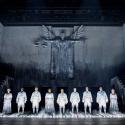
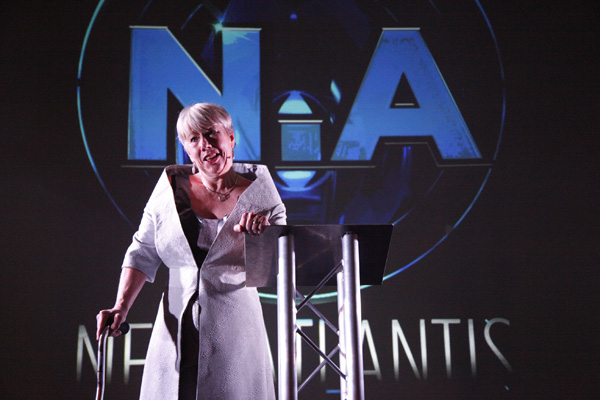 The last half-hour of the two-hour show sees the audience assembling for the final vote. Marcia Weiss, Major Giallo and Nicola MacGloss make their final pitches – we are asked to consider lifestyle changes, asteroid mining, and increased centralisation – and then a discussion begins. The best moment is the intervention of Generation Alpha, those in their twenties, who propose the most radical solutions. By now, this piece of relentlessly immersive theatre is nearing its end.
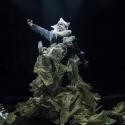
Writer Michael Keane and director Barra Collins are especially good at the first and third parts of the show, with the well-delivered declamatory speeches and mild satire of politico-speech. A large cast – including Tricia Kelly (pictured above) as Bryony Weller, Nicola Blackman (Weiss), Jonathan Jaynes (Giallo) and Nicky Goldie (MacGloss) – work very hard, but there’s no disguising the fact that for most of the show the audience is on its own, and left to its own devices. If that appeals to you as a way of finding out more about climate change, then hurry down to The Crystal: at night, the views from the windows are great.