The Coronet Theatre is a beautiful space – it’s a listed Victorian building, and the bar’s like something out of a film about Oscar Wilde. Unfortunately, Robert Holman’s The Lodger, a new play about family and trauma, doesn’t live up to its surroundings. Director Geraldine Alexander, last seen as the Bridgertons’ arch-yet-kindly housekeeper, salvages a clumsy script that smacks more of a debut than the work of an established writer.
It’s unclear whether The Lodger wants to be a family drama, or a comedy, or something in between. Esther (Penny Downie) and Dolly (Sylvestra Le Touzel) are sisters, “too close to 70 for comfort”. They grew up in Harrogate; Esther escaped to London as soon as she could, writing novels in Little Venice. Dolly stayed behind and married a rich bore. Neither have children, though Esther has taken in Jude (Matthew Tennyson, pictured below, with Le Touzel), an elusive, painfully earnest 27-year-old, and the lodger of the title. The inciting incident is the death of Esther and Dolly’s mother, which propels Dolly down the M1 and into her sister’s home. 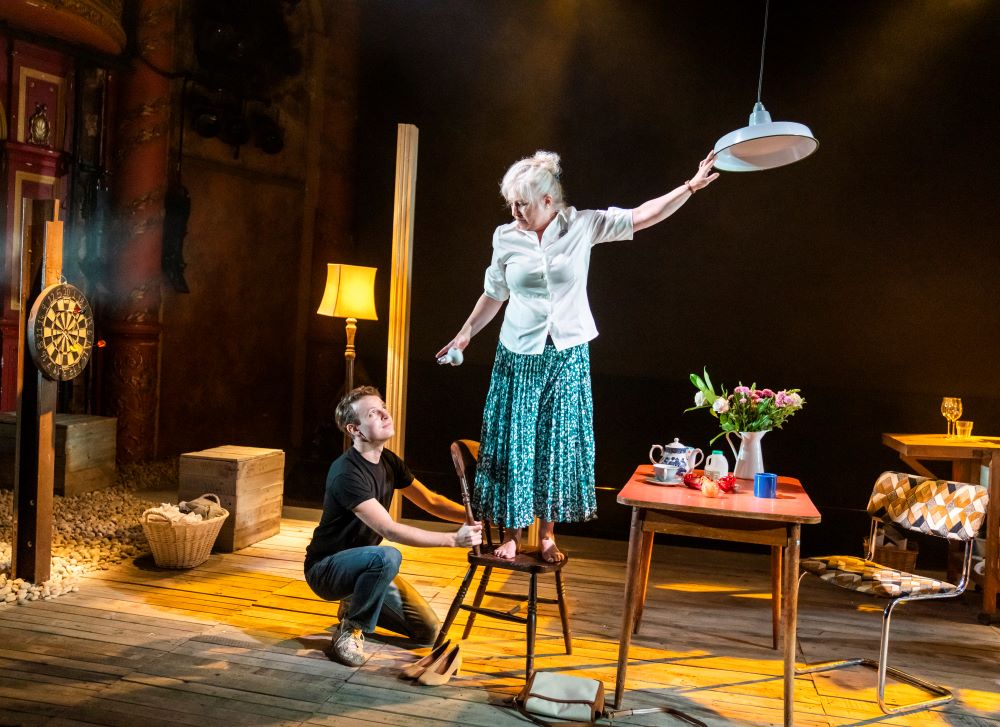 Le Touzel, Downie, and Tennyson have a great rapport, and do their best to make Holman’s strange lines sound like things people would actually say. Le Touzel’s no-nonsense Dolly contrasts with Downie’s brittleness; neither sister is able to maintain her façade (Esther’s of world-weariness, Dolly’s of naivety) around the other. Tennyson, whose brilliant performance in A Monster Calls at the Bristol Old Vic in 2018 was livestreamed over lockdown, uses his wide-eyed, otherworldly quality to great effect.
Alexander gives us some lovely blocking choices: “I can’t write if anybody else is close by,” Esther sighs, blindly holding out her wineglass for Jude to top it up. Wine is a recurring theme in the first act – everybody’s chucking it around Richard Kent’s gorgeous set, stark white-washed floorboards surrounded by white pebbles. It’s a versatile space, cleverly transformed by just a few changes into the beach at Dungeness, “the only desert in Europe”, where Esther writes her novels. David Plater’s lighting reflects off a large mirrored structure at the back of the stage, bathing the actors’ faces in shifting blue waves.
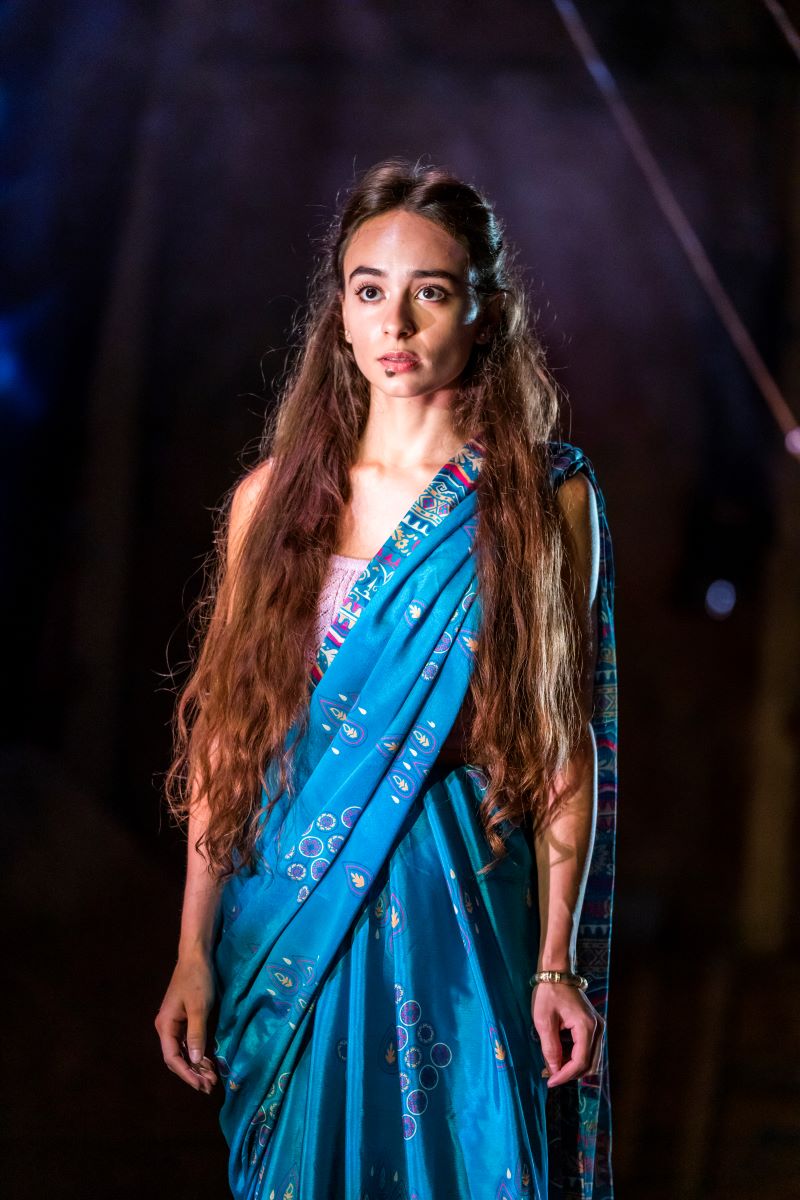 Somewhere under the pebbles and beach detritus, there’s a good play. Holman introduces a new character after the interval, Anila (Iniki Mariano, pictured right), who brings a much-needed shot of energy with her. She’s revealed to be Jude’s cousin, and rapidly becomes his love interest. Then, just as rapidly, she’s killed off, just when Mariano was getting into her stride. “She can’t be dead,” says Dolly when she hears. Couldn’t have said it better myself, Doll.
Holman’s language manages to be direct and obtuse and frustratingly portentous, all at the same time. Jude and Anila refer resolutely to “heroin”, “marijuana”, and “cocaine”, despite allegedly being young people. Occasionally, a good line will break through the fog. “We’re not friends if we’re family,” Anila tells Jude. “That’s a very English thing to say,” he points out, grinning. If only there were more of this.
“It’s beautiful,” Esther says of a play that Jude has written (funny how playwrights always crop up in plays). “It’s full of you.” But exactly who Jude is remains a mystery. The characters spend most of the play telling each other about themselves, as if to make up for their lack of personality, while richer aspects of their inner lives are only teased. Abused in childhood, Jude has OCD and a stammer that reappears when he’s stressed; both of these are mentioned once and never expanded upon. Esther and Dolly’s relationship has potential, but Holman focuses on the men in their lives, and the lack of children, rather than the women themselves. “When people don’t have children, there’s always a story,” announces Dolly. Among the gentlefolk of Harrogate, maybe. But the declarations Holman puts into his characters’ mouths ring hollow, and most of them don’t need to be said at all. At some point, you have to trust your actors to act.