Which of Shakespeare’s plays is most plagued by misperception? For my money, I would argue A Midsummer Night’s Dream. Most people encounter it at school age because of the ease with which it can be dressed up as a light comedy involving fairies. Yet at heart this is a deeply primal work which draws upon the raw power of the elements to look at the arbitrary nature of desire and how radically it can rewrite any individual’s life.
This aspect of the play has informed the RSC’s latest interpretation, though it is rightly the high-tech nature of its Dream that has dominated all the preview attention. This is a revolutionary interpretation for online viewers – created by arts collective Marshmallow Laser Feast – that whirls together motion-capture technology, interactive gaming techniques, and CGI graphics. Beyond that it’s 50 minutes long and has ditched the human lovers. And if you’ve got a soft spot for the rude mechanicals, sorry, they’ve gone missing, too.
In the introduction, hosted by Sarah Ellis, the RSC’s director of digital development, euphemistic references are made to "digital natives and those with less digital literacy", which I suspect translates to something like "entrepreneurs and dinosaurs". As someone who routinely hides her son’s X-Box in the morning in the pre-lapsarian hope that he might enjoy the virtual reality of a book rather than a woefully repetitive simulated car race round Edinburgh, I would seem to be in the latter camp. Yet I was thoroughly beguiled, not just by the sophistication of the animation, but by the magical way in which it channelled Shakespeare’s metaphor. Far from eclipsing the language, it potently evokes the speed with which words play with our reality and transport us to other worlds.
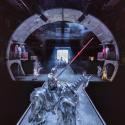
EM Williams welcomes us to the evening as Puck (main picture) – which is appropriate, since it’s arguable that when the Dream’s chief troublemaker tells Oberon "I’ll put a girdle round about the earth/In 40 minutes," they're prophesying the internet. We see them in their motion capture suit, then suddenly we have an atom’s-eye-view as we swirl and descend into a forest. Epic Games, of "Fortnite" fame, is the company that has helped develop the 3-D experience through software with the appropriately Shakespearean name "Unreal Engine". And it works: the next thing we know, Puck is a pagan-style avatar constructed from stones, striding forward into the forest to find – as another author beginning with S might have put it – where the wild things are.
 To return to the virtual reality of Shakespearean metaphor, listen to Titania. At one point, she complains to Oberon that, "the winds, piping to us in vain/As in revenge have suck’d up from the sea/Contagious fogs; which falling into the land/ have every pelting river made so proud/ That they have overborne their continents." This is poetry for a planet plagued by global warming, and this adaptation really makes us feel that reality, whether in the fairies created by swirling leaves or the gale that reduces Puck’s surroundings to a wasteland.
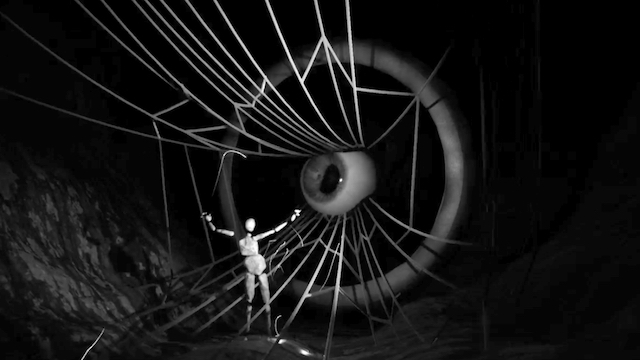
For the interactive element, we are invited to drag around the fireflies who surround Puck and by implication animate them. This is reasonably magical, though again it is notable that where the modern technology keeps up with that ancient technology of language, the most transformative element of the evening comes through another ancient technology – music. There are many visually transcendent moments: Cobweb revealed as a giant eye concealed in a tree-trunk (pictured above), Mustardseed as a wild tapestry of roots. Yet it is in the Vaughan Williams-style swell of the Philharmonia orchestra in the final moments that we really feel the radical sense of nature as the eternal source of reinvention and surprise.
It’s also a mark of the new creative potential offered by this experiment as a whole that Nick Cave has participated as the voice of the forest. This may be nowhere near the traditional Dream, but as RSC artistic director Gregory Doran declares "Shakespeare is robust," and it has found its own magic.
Robin McNicholas’s production is an exciting indicator of the huge range of possibilities in a form that, apart from anything else, promises the holy grail of bringing a large audience of under-25s into the theatre community. As one of the performers points out in the post-show Q&A, Shakespeare was a revolutionary for his time. From the evidence here, there’s little doubt that if he’d had the option of using this kind of storytelling language, he’d have been as attached to his X-Box as any truculent teenager.
- Dream is at dream.online till March 20
- More theatre reviews on theartsdesk