

As an actor, Mark Rylance specialises in outsiders and eccentrics, outliers of one kind or another. He identified and developed his latest character himself, based on the real-life, mid-19th century Hungarian doctor whose pioneering, lifesaving discoveries were long ignored by the medical Establishment – who in his lifetime was a tragic pariah rather than the hero he should have been.
A perfect fit, perhaps. And yet the challenge of dramatising Semmelweis’s story is a tricky one, given a central character who was his own worse enemy and appears to have lacked anything like charisma. This new play, written by Stephen Brown with Rylance, and arriving at the West End via the Bristol Old Vic, is a perplexing animal – passionate, instructive, imaginatively directed, but also sometimes stilted and, at its heart, lacking the nuanced characterisation we have come to expect from its star.
Ignaz Semmelweis was an obstetrician in a period when medical science was making extraordinary leaps and bounds, while still bogged down by elitism, prejudice and those tied to the old way of doing things. Thus the prevailing view of childbed fever, the mysterious infection that was killing thousands of mothers immediately after childbirth, was prehistoric, the uniformly male doctors blaming it on everything from bad ventilation to women’s disposition, rather than failures in their own practice.
At the Vienna General Hospital, Semmelweis noticed that far more women were dying in the doctors’ ward than in that run by the midwives. Attacking the problem with a vengeance, he eventually realised that the problem resided in the personnel: it was the doctors, moving casually between procedures with no knowledge of bacteria, or the need for hygiene, who were carrying death with them.
All they had to do was disinfect their hands. And yet Semmelweis found his revelations falling on deaf ears.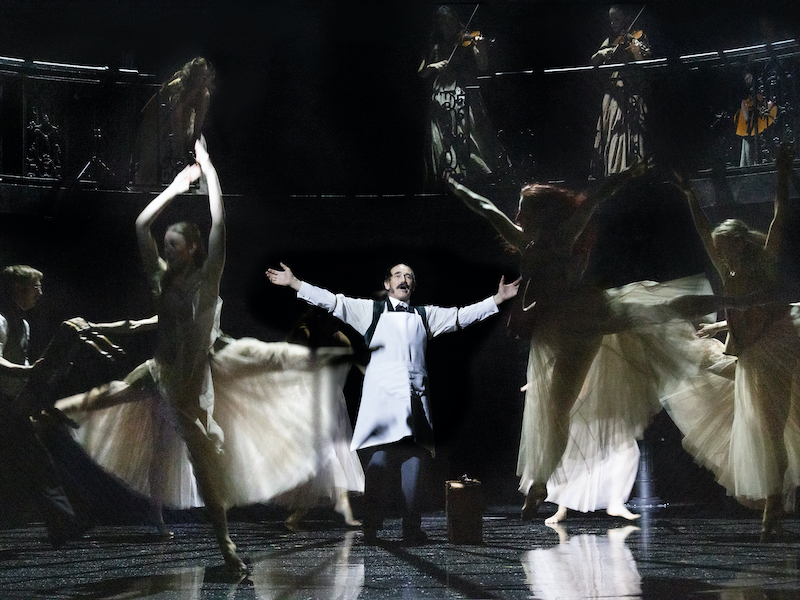 The play opens in Pest, some years after the doctor’s failed attempt at reform, and where Semmelweis is happily married to Maria (Amanda Wilkin) and presiding over a maternity ward with an impressively low mortality rate. But his peace is destroyed with the arrival of two old Vienna colleagues (Ewan Black and Felix Hayes), desperate for him to return and promote his theories to the wider world. Their presence stirs memories, opens up old wounds and, in Semmelweis's increasingly fevered mind, conjures the spirits of all the women who have been lost, he believes, through his own failure.
Aided by Ti Green’s minimal, effective set design (complete with some sombrely attractive 19th century detailing), director Tom Morris (War Horse) moves seamlessly between Pest and Vienna, the real and the imagined, operating rooms and maternity wards, even throwing a theatre into the mix for some comic relief. The result of this nimble direction, driven by string musicians who calibrate the tone and tempo of the action on stage, is very engaging – one moment poignant, as in the death of a patient (Chrissy Brooke) that Semmelweis particularly takes to heart, the other exciting, as the doctor moves ever closer to the root of the problem.
It’s thought that Ibsen modelled his Enemy of the People on Dr Semmelweis’s experience of being a lone voice for good. Meanwhile, the murky space between progress and harm that is captured by Brown and Rylance reminds me of two pieces in other media: Stephen Poloiakoff’s film Century, and Steven Soderbergh’s television series The Knick – set, respectively, at the turn and the early part of the 20th century, both, incidentally, starring Clive Owen, and both capturing the foible and darker inclinations of a profession arrogantly getting off on its advances.
“We are doctors of the modern age,” declares Vienna’s medical showman Karl Von Rokitansky (Daniel York Loh) as he extols the virtues of the new discipline, autopsy. What does the Greek word mean, he asks his students theatrically: “to see for yourself.” How ironic, given that these men are blind to their own mistakes, as they literally transport germs from cadaver to pregnant woman.
 The play is less successful when dealing with Semmelweis’s confrontation with his crusty and obstructive superior at the hospital (Alan Williams, floundering with some pretty drab dialogue) and his angry approach to any obstacle. Over-sensitive of his low status in Vienna (“I’m unorthodox. Dare I say it, Hungarian.”) he demonstrates a bewildering lack of patience and tact, even compassion, throwing charges of murder around the hospital like confetti.
There’s something genuinely tragic here, in that the real Semmelweis’s personality and, arguably, his mental health were factors in his failure. But, while serving the plot, his wayward behaviour doesn’t afford satisfactory drama, because Rylance plays the two extremes – the conscientious, radical hero and the obsessive brute – without marrying the two in a satisfying personal conflict. No doubt the rather mannered scenes of Semmelweis dancing with the mothers’ ghosts are designed to highlight his recognition of his own responsibility, but the play needs more in dialogue and performance to elevate it beyond biography. As we tire with Semmelweis, we tire of the play.
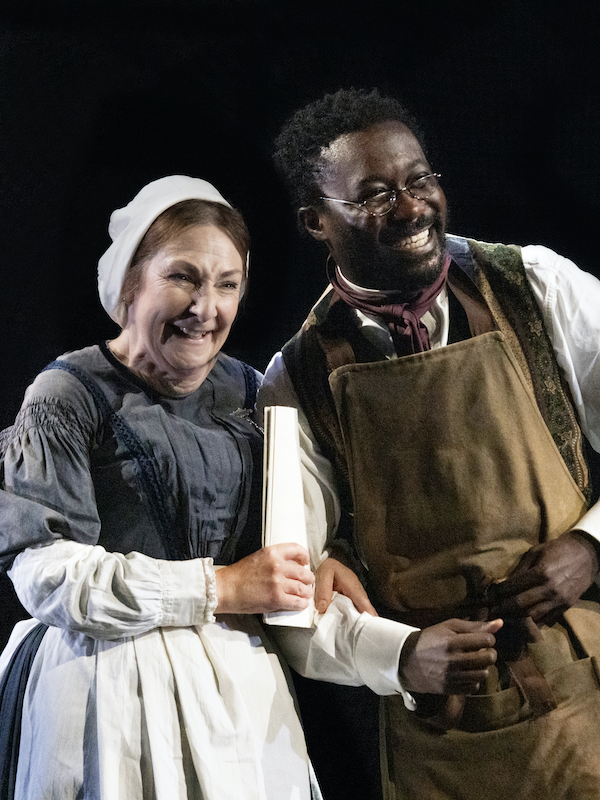
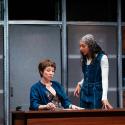
Pauline McClynn excels as the canny and sympathetic nurse who helps Semmelweis, only to have him betray her, as does Jude Owusu (pictured above with McClynn) as the amiable colleague who first offers the play’s lightest moments, then the misfortune that helps to unlock the childbed mystery.









Add comment