Was Tennessee Williams breaking rules, or breaking apart when he wrote this 1969 play? A bit of both, probably, and the two main characters of the rarely performed In the Bar of a Tokyo Hotel face the same choices.
It emerged from what the writer would himself admit was a low period of his life – when grief, alcohol and drugs were major players – and was coldly received. “More deserving of a coroner’s report than a review” was a particularly lethal critical line for a piece that does occasionally seem to stare into non-existence. Sometimes painful to experience, the struggle here is to find much to feel either for, or with its protagonists. Feelings are expressed all right, but that’s not enough always to qualify them as emotions.
Accents are occasionally as all over the place as the emotions
Which isn’t to say that the central character of Miriam Conley isn’t memorable – she is, for reasons she herself, in the kind of sober moment she probably hasn’t had in a while, might prefer to forget. There’s a brittle tiredness to her, a sense of a face just pulled back from grimace, which comes particularly well to Linda Marlowe, for whom Robert Chevara’s production is a good vehicle.
Her presence dominates, virtually without absences through the 90-minute run (one interval), as she occupies a table at the titular venue, where her cocktail hour starts early. Her immediate conversation partner – though partnership is hardly a word we’d associate with her – is the barman (Andrew Koji), whom she’s trying to seduce with a strangely desperate, yet almost dispassionate process of self-revelation.
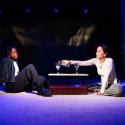
The initially absent presence is husband Mark (David Whitworth, pictured below with Linda Marlowe), upstairs in his room, an artist who’s convinced he’s on the verge of making crucial breakthroughs in artistic creativity (think, loosely, Jackson Pollock). He’s talking of “crossing frontiers” into new forms – which tempts comparisons with Williams himself, moving away here from the structures of his earlier, better-known work. Mark is on a cliff-edge, crawling naked over his canvases offstage, paint flecked all over him the first time he appears.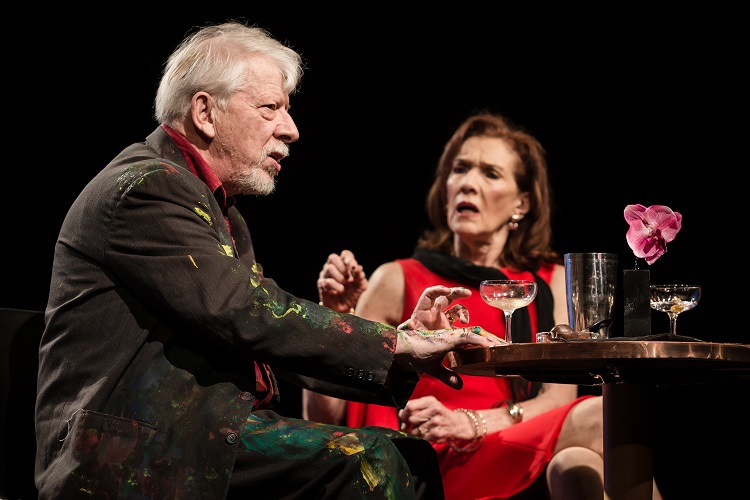 In one of her best lines – she has many, some macabrely comic, others rising to greater poetry – Miriam talks of “controllable limits”, and she clearly thinks Mark has gone beyond them. Though her own behaviour, as she recounts it (the promiscuity, the nihilism) has long crossed most lines. Three decades of marriage behind them, this relationship has somehow moved beyond vehement antagonism, shading into a sense of a “constant unbearable” that is as much exhaustion as anything else.
But Miriam’s worry that this time it has gone too far has prompted her to cable her husband’s gallerist, the smooth Leonard (Alan Turkington), whose readiness to drop everything attests to the reality of Mark’s talent (and certainly its bankability). But really she has summoned him for her own reasons, to hand the burden of stewardship on to someone else, before striking out, at last, on her own. Freedom will prove two-edged, however: the play’s denouement, which comes sotto voce after a lot of noise, may free her on one level, but knocks the life out of her on another.
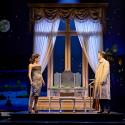
Harking back more to the Fifties than the end of the Sixties that is the play’s period, Nicolai Hart-Hansen’s raked design rises elegantly above this all-too-human bickering, its colours soft against personal interactions that are anything but. It's certainly convincing, in a way not always felt elsewhere: there’s been much critical talk about how Williams was trying out new types of dramatic language here – drawing on Japanese theatre forms, Noh and Kabuki, which he’d been introduced to by Yukio Mishima, no less – and aiming for different expression structures, but Chevara’s production could do more to bring any such elements out. Accents are occasionally as all over the place as the emotions. But Linda Marlowe's no-holds-barred perfomance gets under your skin whether you like it or not, and her pairing with Whitworth – she loquacious, always sharp; he quieter, somehow malleable – at its best has the compulsion of a car crash.