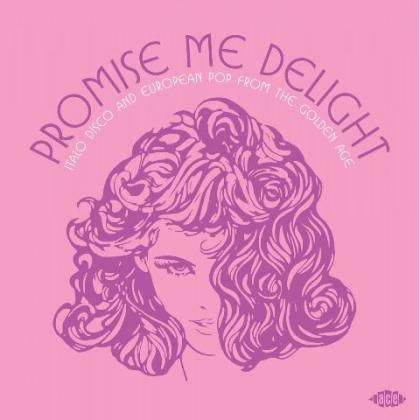
“Promise me delight” is a tantalising entreaty. One which – in its particular way – this captivating 17-track compliation delivers on. Promise Me Delight - Italo Disco and European Pop from the Golden Age digs into what its title articulates, with the golden age in question spanning 1982 to 1988, with an emphasis on 1983 to 1986.
A specific form of Continental European pop is celebrated. One which was dancefloor oriented, with electropop leanings and an emphasis on tunes as much as on atmosphere and rhythms designed to move body and feet. Not much of this pulse-quickening, often-fervid, almost-tumescent music hit Britain’s charts, but Hi-NRG and characteristics of what The Human League, New Order and Pet Shop Boys were doing in the chosen period are simpatico with the ethos of Promise Me Delight. One of Saint Etienne’s fundamental building blocks rests in this music, as do large dollops of Stock Aitken Waterman's guiding principles. Madonna was doubtless cocking an ear too.
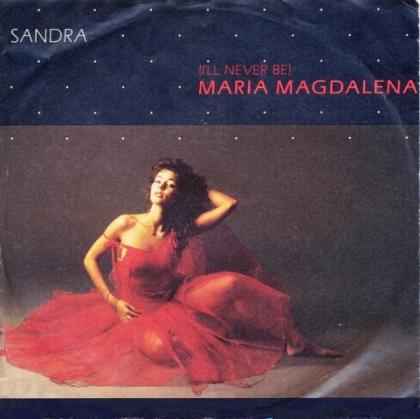
The title is taken from the lyrics of Sandra’s massive 1985 Continental European hit "(I'll Never be) Maria Magdalena.” In its chorus, she declares “I'll never be Maria Magdalena, Maria Magdalena.” Between each of her lines, the interjections “Promised me delight, You're a victim of the fight, You need love.” The vocal melody is yearning, the use of an EMU Emulator, a Synclavier and a gated-sounding, programmed rhythm track (probably from a Linn drum) point to an Eighties origin. It’s pop in the poppiest sense, rather than a record born from aspects of the knowing reconfiguration of mainstream British music which occurred in the wake of post-punk and the consequent emergence of the New Pop. Most importantly, "(I'll Never be) Maria Magdalena" is a fantastic record – an enduring masterpiece.
Its singer, Germany’s Sandra Ann Lauer, first appeared on record at age 15 in 1976 with the manic, string-infused, Euro-disco, schlager-rooted single "Andy Mein Freund." After this, a break from singing. Her next release was in 1985. Throughout – into and beyond the period when "(I'll Never be) Maria Magdalena" was released – she worked with the same songwriting/production team. "(I'll Never be) Maria Magdalena" is the opening track of Promise Me Delight.
Obviously, the title Promise Me Delight - Italo Disco and European Pop from the Golden Age makes it clear what's collected isn’t entirely Italian. Demark, France and Germany also crop up. For the British charts, the first sniff of the cross-border Continental European dance-music alliance along these lines was arguably Donna Summer’s “I Feel Love”: sung by an American, recorded in Germany and written and produced by the Italy-born Giorgio Moroder. A less future-facing dance-slanted Italian arrival in the UK Top 40 came in 1978 with Raffaella Carrà’s “Do it do it Again, an English-language reconfiguration of her “Forte Forte Forte” single. The set’s enthusiastic, interesting liner notes point to Sicily duo La Bionda’s 1978 synth-based hit “One For You, One For me” – 54 in the UK charts – as a pivotal record. As for the term “Italo-Disco,” it first appeared on the sleeve of a 1982 single by the Italian duo Amin-Peck issued by the German ZYX label. Cross-border fluidity, indeed.
This went further than Europe. Den Harrow, whose wondrous all-time classic “Catch the Fox (Caccia Alla Volpe)” is collected here, was a confabulation. Records with the Harrow credit were sung by America's Tom Hooker, while promotion – including miming for TV and photo sessions – was undertaken by Italian model Stefano Zandri, seen here in the header on the sleeve of “Catch the Fox (Caccia Alla Volpe).”
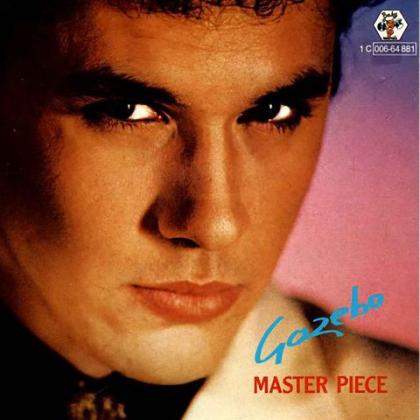
From an Anglo perspective, the compilation’s best-known names are Desireless and Stephanie (i.e. Princess Stéphanie of Monaco, whose 1986 singles are uniformly great – better than her pretty weak 1991 album). From a Continental European perspective, Iván, Kano, Laban (from Denmark), Sandra and the fantastically named Gazebo are or were mainstream names. Even if some of those credited on labels aren’t familiar, what’s recorded may be: RAF’s “Self Control” is the original of the track which Laura Branigan covered.
One of core reasons Promise Me Delight scores is that it is unironic – the music is not presented as a novelty or a form of exotica. Instead, it is laid-out as what it is: pop, with cutting-edge inclinations, a pop designed with sales potential in mind. Albeit though, in the main, a pop which did not cross the channel to find a British audience during the period it was being created. For Italy, Spagna’s “Call me” (1987) and Sabrina’s New Order-esque “Boys (Summertime Love)” (1988) were as far as it got with the higher reaches of the British charts – although a fair argument can be made for Giorgio Moroder/Philip Oakey’s “In Electric Dreams” as an Italian creation. These were hints; hints that there was more to dig into in Continental Europe. That digging is done here.
There have been previous Italo-Disco compilations, but the widescreen view taken by the long-overdue, nicely presented Promise Me Delight - Italo Disco and European Pop from the Golden Age ensures that this compilation firmly and instantly positions itself as one of the year’s most notable archive releases. Get this. It’s a delight.
- Next week: David Westlake's 2002 album Play Dusty For Me
- More reissue reviews on theartsdesk
- Kieron Tyler’s website