

Pénombre, penumbra: "The partially shaded region around the shadow of an opaque body, when the light source is larger than a point source and only part of its light is cut off (contrasted with the full shadow or umbra)." Pénombre, penumbra: "An area where shade blends with light; a shadowy area." Pénombre, penumbra: "A faint intimation of something undesirable; a peripheral region of uncertain extent; a group of things only partially belonging to some central thing." So even as we start, we are already in the shadows.
dance reviews
Ismene Brown

Catalan dance is one of Sadler’s Wells’ themes this spring, though I’d love to know how much of what Tap Olé does can really be called Catalan - this is a tap fusion company that owes its germination to Riverdance, Tap Dogs and the efforts in New York recently to revive rhythm tap. Attaching tap class skills to Spanish guitar makes what’s on at the Peacock this week more a tap show in a tourist-trail tapas bar than a theatrical dance production worth a detour.
Ismene Brown

Can one enjoy watching a film supposedly about dance in which competition and being Number One is all and the word “artistry” is not mentioned once? And in which performers are nameless numbers? And the documentary-maker shows not a scintilla of curiosity about why this might be? One might, if it were handled with a twisted sense of humour and cutting observation.
Ismene Brown

If you’re looking for a surprising and off-the-wall show this school holidays, I’ve no hesitation in hugely recommending Chouf Ouchouf, a brilliantly and theatrically inventive acrobat theatre show performed by the Groupe Acrobatique de Tangier, a troupe of Moroccan acrobats who learned their awesome skills on Tangier Beach. Through the wit and imagination of its Swiss theatre directors, the show manages to retain a lively street smell and yet pull off some deft theatrical effects, blurring the edges between normality and strangeness - one moment you feel you might be walking in a souk, the next you’ve been sucked into a darkling, ghostly world of surreal human balancing acts.
Ismene Brown

Manon, Manon, the little minx. Here she comes again - for the 223rd time, last night - and like the legendary ladies of her trade, scrubs up fresh and newly captivating, as if she’d only just skipped off the carriage from the convent.
Ismene Brown

Pina Bausch decided: “Words can’t do more than just evoke things - that’s where dance comes in.” Well, up to a point, Lord Copper. Only if they’re bad words and good dance - bad writhing instead of, say, Shakespeare’s words isn’t much of a swap. But with Bausch, people tended to hang on every word, probably because so much of her dance was indeed pretty damn good, and it’s so difficult to put into words just why that was.
judith.flanders

Sometimes, watching contemporary dance, you feel that no choreographer has ever known a happy moment – such angst, such grief, such terrible agony rolls over the footlights out to the audience that arriving at the theatre feeling mildly content can seem like an act of subversion. On their last night of this too-short season, however, Anne Teresa de Keersmaeker’s Rosas company produced one of her most joyous and enjoyable pieces. For as the choreographer reminds us here, joy, cheerfulness and even sheer good temper are also emotions, and also worth exploring.
Ismene Brown

We’ve been so well educated or so roundly brainwashed to expect a certain high standard of Russian ballet that to experience the first two programmes of the three offered by the “Russian Seasons" team at the Coliseum, so-called tributes to Diaghilev, is more than a shock - it’s a brain injury.
David Nice

Anyone who feels, as I do, that the Aesthetic Movement's "cult of beauty" now on display at the Victoria and Albert Museum can't compare with the fabulous Ballets Russes exhibition which went before it can dine again on a feast of Russian colour at the Coliseum. You'll eventually be rewarded, in this Kremlin Ballet-based company's first show, with the closest to the spirit of 1910 a recent London Firebird has ever come. Whether the choreography and the music for The Blue God have more than the loosest connection with Diaghilev is another matter.
Ismene Brown

As the young waitress said in the restaurant where we ate after last night’s world premiere of Ashley Page’s Alice in Glasgow, she hadn’t ever been to ballet, but she was tempted to go for this - “It’s Alice after all, isn’t it? Wonderland. I’d love to see Wonderland.” The kind of new audience that any company should kill for.
And my friend said, sadly, yes, that’s what we’d also supposed it would be. "So shall I go?" she said. We said, um, you’re right. Ballet is the one place where you really can hope to see Wonderland, the unsayable, the merely imaginable. But there is always the danger that you’ll be put off ballet if you see something that messed it up. Three hearts sank together.
This production starts from a much firmer premise than Christopher Wheeldon’s failure de luxe at the Royal Ballet last month: the idea that Lewis Carroll, real name Charles Dodgson, was as much a photographer as an author, and that his fantastical writing came from his dissociative habit of looking at life through a lens. Alice therefore - we surmise - exists both in front of the lens (the real Alice) and behind Dodgson’s (the vision he wishes to shape of her).
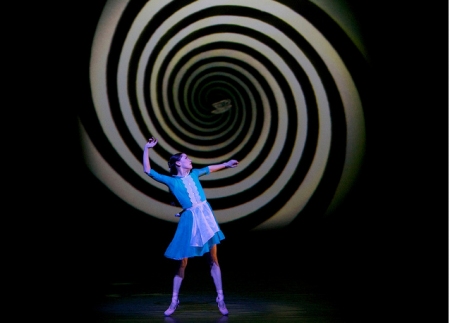 To further this fruitful idea, the stage is dominated at the start by a gigantic bellows camera, which after Alice dives through the lens, splits open to show a black box behind which looms a large antique mahogany slide-camera frame. This is a very clever setting for a dual layering of activity, the associative memory provided by projections in the frame, and the “real” episodes on the stage.
And it’s really quite like Monty Python’s old tricks; superb costuming by Antony McDonald - the suit of Hearts are triumphs of sharp, fantastical tailoring (see the gallery below) - their very real presence complemented by the alluringly surreal video work of Annemarie Woods, acting like the Terry Gilliam in the Python team, sneaking in her strange visions behind the action in the photo frame.
All goes very well in the design department - it’s in the choreographic, dramaturgical and musical areas that things rapidly become unstuck. Page, like Wheeldon in London, has relied too much upon his designer, McDonald, to package the favourite episodes, and on the composer to provide yards of musical lining, as he has no linear drama to provide for his part. But the composer, Robert Moran in this instance, can work as hard and as ingeniously as he might to provide yards of music for Lobster Quadrilles, Humpty Dumpty (half baby, half egg, all silly), Tweedledum and Tweedledee (schoolgirls) and whathaveyou, but he is seriously up Indecision Creek if the co-directors show no belief in what the various dance episodes are adding up to. And for long periods one feels Moran killing time with cool, arrhythmic percussiveness - lots of marimbas, wood blocks, drums - in between strong waltzes and Pulcinella-like courtliness, just waiting for an instruction about an emotional destination.
The reason the public loves Alice is because she’s an enigmatic mirror for their imaginings. By contrast, Charles Dodgson is stuck with a modern reputation as a faintly weird man who liked to photograph a pre-pubescent child naked. Frankly, had Page decided to do Alice as a variant of Humbert Humbert and Lolita he’d have both served his designers better and given himself a real theatrical focus of emotional immediacy.
As it is, this is an endurance test of a ballet, two hours plus the interval, trying for children and adults alike, in which charm goes begging yet risks are refused. Alice, danced by the exquisitely elegant and intelligent Sophie Martin, isn’t the true heart of the ballet because her series of pas de deux with Dodgson travel nowhere, despite her growing older. The third duet is the outstanding one, sincere and honest, two people in frank sexual imbalance, he yearning for her, she tempted but refusing - the best of Page’s work in the night. But Dodgson feels like the missing centre of this character ballet - despite his omnipresence, Page consigns the inexpressive Eric Cavallari to a bland proto-Classical idiom that yields no insight into who Dodgson might be.
Annemarie Woods's strange and succulent video visions seem to have the measure of the book in a way the choreographer doesn't
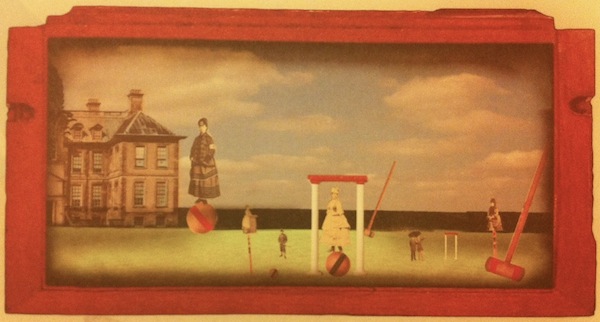 Yet what Annemarie Woods’s strange and succulent visions in the back frame (a drawing of one, pictured left) mesmerisingly suggest is the rich confusion, the unorthodox interior landscape, of a young, awkward Victorian man obsessed with the sexual wonderland of a girl and her changes from an easily understood child into a completely baffling young woman. Often it’s the ocean that we see in her Dalí-esque visions, peppered with little bobbing Alice heads at different ages, or proudly bearing an approaching sailboat with her standing on it like Botticelli’s Venus, but invested with a lobster crown and a jam tart shield, a parodic Britannia, queen of the ungovernable currents inside Dodgson’s head. Woods does seem to have the measure of the book in a way Page doesn’t.
Here and there one catches a glimpse of the much more interesting ballet Page might have done had he been braver, in the echoes he draws with the dark male characters of MacMillan’s ballets that he himself once played, from Tybalt to the King of the South in Prince of the Pagodas. The tangoing Caterpillar, with his huge mushroom and dangerous hookah, is quite a sleazy menace to a young girl. The ménage à trois of the Mad Hatter, March Hare and Dormouse has associations with two men oppressing a little girl in her pyjamas for sinister reasons. The Jabberwock, a fearsome-looking axeman with a black executioner’s block covering his head, is unmasked as a fevered, almost vampiric young man.
The visions they present are not as vanilla as the dance they do. This production strongly suggests something undeveloped, film left in the camera, visions sanitised in the processing. All add up to a long, antiseptic and resistible experience. Not Wonderland. Off with their heads.
OVERLEAF: ALICE'S ADVENTURES ON STAGE AND SCREEN