

A new baby is like an alien invasion: it blows your mind and it colonises your world. For any couple, parenthood can be both exalting and devastating, with the stress hugging the relationship so tightly that eventually all its lies pop out.
theatre reviews
The Lady from the Sea, Donmar Warehouse review - Nikki Amuka-Bird luminous in a sympathetic ensemble
David Nice

What a profoundly beautiful play is Ibsen's The Lady from the Sea. It stands in relation to the earlier, relatively confined A Doll’s House, Ghosts and Rosmersholm as Shakespeare's late romances do to the more claustrophobic tragedies. And with what apparent ease, art concealing art, do director Kwame Kwei-Armah, the Young Vic’s next Artistic Director, and the diamantine new performing version by Elinor Cook transport us in the Donmar Warehouse from a Norwegian fjord in the 1880s to the Caribbean of the 1950s.
Nothing is lost of the play's essence, the race issue only brushed in with the lightest of touches to suggest the heroically enduring protagonist’s ties to her village and her role as the lighthouse keeper's daughter, a sudden reversion to the Caribbean accent tellingly placed when she’s under the spell of a not-so-past infatuation. In this setting the three would-be-independent women still have obstacles to overcome, and islanders are perhaps even more susceptible than fjord-folk to the myths and magic of the sea.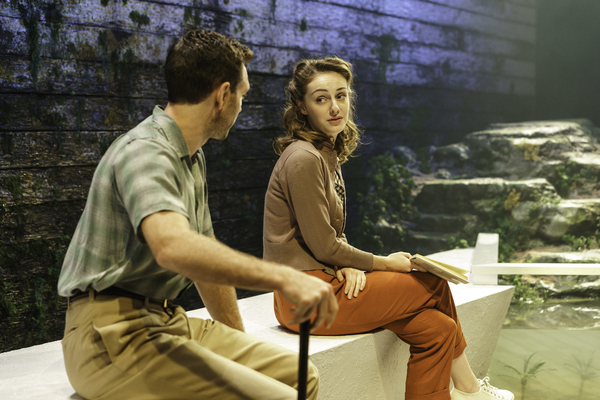 It's not easy to buy into the melodrama of an uneasily married woman in thrall to the pledge, or curse, forced on her 16-year-old self by a murderous Flying Dutchman. Ibsen, and Cook, get round it through the reasoners of the play questioning its supernatural nature, as do we - and eventually the heroine, too; and they make it subservient to the question of what freedom is, for men as well as women, in relationships and marriage contracts. The symbol of rings that bind and can also be loosened is especially telling. Cook extends its significance magically in an ending that is more poetic than Ibsen’s.
Unusually for Ibsen, all the participants other than the Stranger are sympathetic, needing no special light shone on their characters for us to love them. Kwei-Armah's cast make us know who they are as people very quickly, and our attitudes tend to be of smiling complicity rather than the usual Ibsen-induced shock or alarm. Jim Findley's Renaissance man Ballestrad, painting a picture of a half-submerged mermaid which buys into the misogynist nature of such legends, eases us in; Helena Wilson (pictured above with Tom McKay's Arnholm) and Ellie Bamber (pictured below with Jonny Holden), real and recognisable, respectively make us like the capable elder daughter of the widowed and remarried Dr Wangel, Bolette, who’s her own worst enemy, and her stroppy adolescent sister (the name, Hilde Wangel, is of course to take on great significance for Ibsen when she re-emerges in The Master Builder).
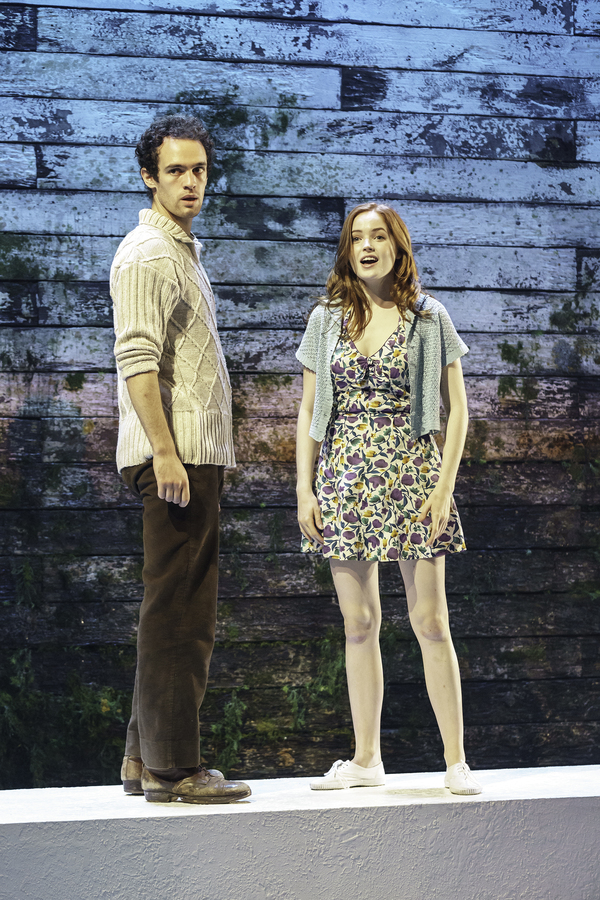 The outsider men are fine-tuned, too. You know immediately what you’re to make of the consumptive young Lyngstrand, a pretentious sculptor doomed to failure if he doesn’t die first, in the physically and vocally note-perfect performance of Jonny Holden; Tom McKay as Arnholm, the girls’ former teacher scarred by the war, is a model of wistful, pained sympathy. Jake Fairbrother as the Stranger seems nominally too young – the big theme is about four characters pushing 40, facing a disillusioned future if they can't relinquish the power of the past – but conveys the necessary power of malice as well as the energy that attracted Ellida to him in the first place.
Nikki Amuka-Bird (pictured below) refuses to succumb to the this-is-the-star syndrome of previous Ellidas. She’s a team player, reacting vibrantly to everyone around her, but finely draws from her first appearance in the action of the play the nervous volatility that spells out the sea-lady’s weight of inner conflict. The big cries of frustration and alarm are all the more impressive coming from a context that’s believable and real. Finbar Lynch’s Wangel complements her to perfection – a quiet man, good but damaged, whose struggle with giving her the freedom she needs is, like everything else in this production, totally convincing. The denouement can seem glib, but not here, given the hypnotic power of these key interpretations.
 Tom Scutt’s set within the intimacy of the Donmar has the difficult task of conveying both the distant sea and the tree-fringed hilltop residence with its ornamental pond. Instead of going for the realism inherent in Ibsen’s characterisations, he strips the action away to a tank upstage left, with submerged models, slippery rocks above and water into which the two elemental characters half-submerge themselves at judiciously placed moments. The wall at the back, spattered with the mould of the tropics, is superbly transformed by Lee Curran’s lighting in the last act to suggest a sunset at sea. I could have done without any music other than the offstage carnival band that’s demanded by the setting, and the acting is strong enough to carry the weirdness of flashbacks without any need for soundscape underlining, but neither optional extra is too intrusive. What you take away are both lightness and depth, and there could be no greater honour to the balancing act of Ibsen’s great human comedy than that.
- Nikki Amuka-Bird interviewed on theartsdesk
- The Lady from the Sea at the Donmar Warehouse until 2 December
- Read more theatre reviews on theartsdesk
Overleaf: more Ibsen on theartsdesk
Katherine Waters

In David Ireland's new hour-long two-hander – a co-production between Soho Theatre and west London's Orange Tree – two strangers, Janet and Dermot, meet for a casual hook-up arranged over the internet. The glitch, or at least surprise: she appears dressed as a mouse.
Marianka Swain

A hit on Broadway, David Ives’s steamy two-hander now boasts Natalie Dormer and David Oakes, well-known for their screen work, in its West End cast, with Patrick Marber on directing duties.
Aleks Sierz

Prolific writer Mike Bartlett is the most impressive penman to have emerged in British theatre in the past decade. The trouble is that his work is so uneven. Although he wrote the amazingly imaginative play, Earthquakes in London, and the Shakespearean West End hit, King Charles III, he has also been responsible for the preposterous improbabilities of the second series of the BBC’s Doctor Foster.
Veronica Lee

In a rather clever wheeze, Dominic Dromgoole, former artistic director of Shakespeare's Globe – who therefore knows a thing or two about historically accurate stagings – has established Classic Spring, a new company dedicated to celebrating work by “proscenium playwrights” and staging their plays in the theatres they were written for.
Sam Marlowe

Loneliness: in the age of the digital hook-up and the flaunting narcissism of social media, it’s become a strange sort of taboo – a secret shame, the unsexy side of singledom. So it’s good to see playwright David Eldridge putting it centre-stage in this tender, pleasingly unsentimental two-hander.
Ismene Brown

The awful mother, the celebrity-obsessed teenager, the mediocre old writer who wants some young sex in his life – there are motifs in Chekhov’s The Seagull that fly merrily from one century to another, and Simon Stephens and Sean Holmes’ new modern-dress update for the Lyric, starring Lesley Sharp, is fresh and acco
Jenny Gilbert

God makes few appearances at the modern playhouse – so few that the Finborough Theatre saw fit to print a glossary in the programme for its latest production. What begins with Agnostic, Annunciation and Aramaic runs all the way to Spirit Guide, Utopia and Vespers, which gives some idea of the breadth of reference to be found in this tightly constructed three-hander by New York writer Keith Bunin.
Matt Wolf

What a difference an ocean and a change of scale can make. When I saw the Mel Brooks musical Young Frankenstein on Broadway a decade ago, the show seemed to take its cue from the lumbering monster contained within it, who stutters and sputters before eventually being kickstarted into something resembling life.