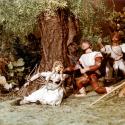
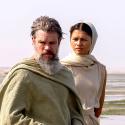
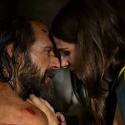
The Gospel of Us is a film about remembering. It is based on and was filmed at The Passion of Port Talbot, Michael Sheen’s triumphant theatre-event that took over his home town in south Wales to retell the Easter story this time last year. Writer Owen Sheers has novelised The Passion as The Gospel of Us. Continuing the chain of collaboration and adaptation, director Dave McKean has taken this title and managed the incredible dual task of producing a lasting memorial to the incredible events of that weekend while also making a film that stands in its own right as part of the pantheon that recount “the greatest story ever told”.
Drawing on every skill from his background in illustration and graphic design, as well as in film, music and sculpture, McKean has put his hand into the metaphorical box of memories and dug out something new from the unenviable amount of material that must have been at his disposal. The Gospel of Us is not merely the 72-hour marathon of the original live theatre event condensed artfully into a digestible two-hour feature film; it is a masterclass in imaginative film editing and the product of an endlessly inventive esoteric mind.
Sheen and Sheers have had their praise; now it is Dave McKean’s turn
McKean uses the trope of omnipresent mobile phone coverage by the audience as license to turn in a startlingly original cinematic collage. Just as in National Theatre Wales’ epic piece of street theatre we were treated to total immersion in the experience, here we are subjected to another feast for the senses. McKean mixes stylised filmmaking and warm, unobtrusive moments that seem almost “off-camera” in the way they are delivered (for example Sheen’s breaking of sandwiches with a group of the local populace in a heart-warming adaptation of the feeding of the five thousand).
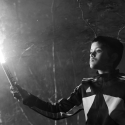
The limitations imposed on McKean by the nature of live performance only serve to force innovation: Sheen’s 40 days in the wilderness are reported by the star himself via hand-held camera, providing some touchingly personal moments; the director plays with time and chronology, flashbacks and jump-cuts adding to the film those elements near-impossible in the theatrical medium; there are dream-sequences and frames tinged with sepia and the exaggerated colours from McKean’s background as Batman graphic novelist and illustrator for the book that accompanied the Rolling Stones’ Voodoo Lounge.
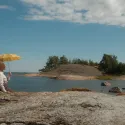
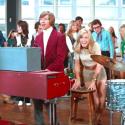
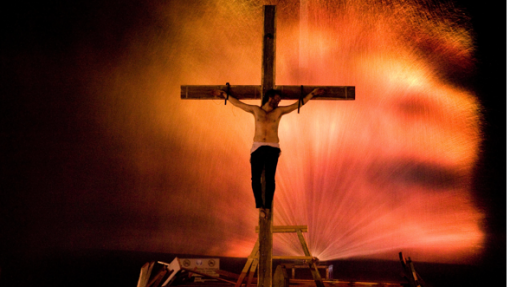 But for all its cutting-room wizardry, the film is not just an exercise in trickery. At its heart is a very human story. Many tender moments the crowds will have missed are captured in close-up by McKean’s cameras. During the Supper at the Seaside Social Club, Alfie (Darren Lawrence), one of the latter-day disciples The Teacher has picked up on his travels around the town, sheds a single tear. It is part of the performance of course, but it is genuine emotion too; Alfie – Lawrence – was not the only one to shed tears that weekend. And just like in its source material, the film manages to make the town itself the star of the show, although admittedly it is the location rather than the all-important people which gets star billing here: the sulphurous glow of the steelworks and the fire from the chimneys, the yellow-green gorse and bracken of Baglan moors, the shimmering waters of the Bristol Channel and “the monster with stone legs” – the ubiquitous M4 motorway which passes over the town.
Charged with the almost impossible task of rendering a magnificent piece of theatre into another artform, The Gospel of Us incredibly manages to serve as a reminder of what film can achieve when approached with a mix of sensitivity and passion. Sheen and Sheers have had their praise; now it is Dave McKean’s turn. In its best moments, The Gospel of Us captures something universal in the specific story of what happened in Port Talbot last Easter. In doing so, it not only helps those who were there to remember what they saw, and heard, and felt; it reaches out to everyone. Us is us all.