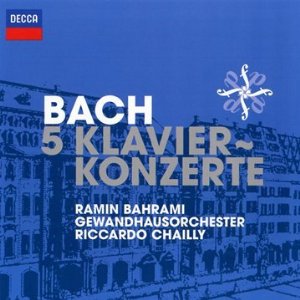
We’re spoilt for choice in these concertos; Perahia, Schiff and Hewitt have given us excellent versions, and another new one by Alexandre Tharaud has just been released by Virgin Classics. I prefer Bach’s solo keyboard music played on piano, but I’m willing to concede that period instruments can suit the keyboard concertos better, given the delicious contrast in timbre between harpsichord and bowed strings. These readings, played by the Iranian-born pianist Ramin Bahrami, are good enough to make me never want to hear a harpsichord again. Subtly faster speeds mean that it’s possible to squeeze all five concertos onto one disc. And, combined with Chailly’s immaculate, big-hearted accompaniments, Bahrami’s effortless style and panache make listening to the disc a life-enhancing experience. Bach can be a scarily intense composer, but these pieces are among the most approachable he produced. The many sequential passages sound reassuringly predictable in places. You think you know what’s coming next and start humming along, only to be wrong-footed by a quirky modulation or turn of phrase.
Bahrami plays with a jazzy flexibility and real sense of fun; passagework is immaculate and his left-hand technique is superb, notably when the D minor concerto’s main theme bounces around in the bass under right-hand trills. He rarely touches the sustaining pedal, so the clarity is dazzling. In less flamboyant mode, Bahrami is compelling – the slow movements of the D major and F minor concertos offer some of the most poised, musical playing you'll hear. Essential listening - Chailly’s recent modern-instrument Bach recordings have all triumphed, and this disc is no exception.
Watch Ramin Bahrami play the Largo from Bach's Fifth Keyboard Concerto
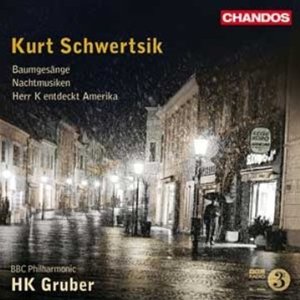
Listening to new music can be more of a dutiful slog than a pleasure. This disc of music by the quirky Austrian Kurt Schwertsik is a consistent joy. Schwertsik was born in 1935, attending courses in Darmstadt where he encountered music by the likes of Stockhausen, Cage and Nono. His own compositional style soon became far more eclectic, and he became a member of a group known as the Third Viennese School - writing music which was broadly tonal, paying homage to composers from Mozart to Webern. Schwertsik is far more than a skilled pastiche artist – ghosts from several centuries of Western art music drift in and out of these scores without overwhelming a distinctive and drily witty personality. Mahler and Janáček make their presence felt in Nachtmusiken; the title a reference to the two nocturnal inner movements of Mahler’s Seventh Symphony. The opening movement is an affectionate tribute to Janáček - a tender tour de force of nagging ostinati, speech-like melodies and glowering brass chords.
The Kafka-inspired Herr K entdeckt Amerika is more eclectic; there’s a pitch-perfect Mahler send-up in the second movement and nods towards Minimalism in the brief finale. The third work on the disc is 1992’s Baumgesänge; six arboreal miniatures encompassing a staggering emotional and musical range within a 21-minute span. The BBC Philharmonic play with phenomenal swagger and they’re conducted by HK Gruber – a long-time friend of the composer. Gruber’s contribution to the CD booklet is fascinating – he writes of Schwertsik’s view of tonality “as an old machine, as old as humanity… we had to lubricate it and learn again how to run it”. Fantastic stuff, and sumptuously recorded. Nice cover photo too.
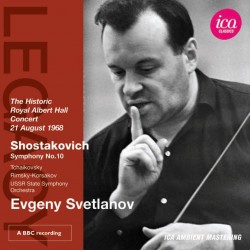 Shostakovich: Symphony No 10 USSR State Symphony Orchestra/Evgeny Svetlanov (ICA Classics)
In which a famous foreign orchestra’s visit to an August Prom is disrupted by audience protests. This is not the Israel Philharmonic in 2011, but the famous occasion in 1968 where Evgeny Svetlanov’s orchestra came to play in three Proms, unfortunately coinciding with the arrival of Soviet tanks on the streets of Prague. In a remarkable accident of programming, Mstislav Rostropovich played Dvořák's Cello Concerto in the first half. Colin Anderson’s sleeve note recounts how the tension in the hall had dissipated by the time of the interval, but the opening rumble of Shostakovich’s Tenth is inaudible under the audience noise; ironic given that this was a symphony by a composer who had long enjoyed an uneasy relationship with authority. Is the performance worthy of more than historical interest? Yes, it is – there’s a savage intensity to the playing that must have been partly due to the atmosphere present. Svetlanov’s opening Moderato builds inexorably, making shrewd use of the USSR State Symphony Orchestra’s magnificent lower strings. There’s not an ounce of fat in this music – every bar, every phrase counts, and the closing piccolo duet is a chiller. The four-minute Scherzo really screams, and the sheer muscularity of the string playing is astonishing, despite the occasionally murky mono sound.
Shostakovich’s emotionally ambivalent third movement still baffles – are the horn calls an oblique Mahlerian reference or a declaration of love? Svetlanov’s fast speed for the main section of the Finale is tackled with complete security by his players. He brilliantly captures the shift in mood from the jauntiness of the opening clarinet theme to the menace as the music collapses eight minutes in. And after the composer’s DSCH motto blares out on horns and lower brass for the last time the audience erupts. It’s gripping. There are also items recorded during the following two Proms – Tchaikovsky’s Melodrama from The Snow Maiden, and two extracts from Rimsky-Korsakov’s Invisible City of Kitezh. Each is beautifully, idiomatically shaped and ecstatically received.