

Nearly there. In one more day the phoney Games will be over and the real drama can begin. For the past weeks the television schedules have jostled with documentaries about past Olympians and current ones, while Chariots of Fire has been going for gold in both the theatre and the multiplex. There was just time last night for one final Olympic story to be smuggled under the wire. The remit of Bert and Dickie seemed clear: to remind us that we’ve done all this before, in much more trying circumstances, and the whole thing united the nation in a warm glow. So there.
The on dit is that Team GB does best when sitting down: ridin’, pedallin’, boatin’ etc. In fact, until Steve Redgrave embarked on his long trawl for medals in 1984, British rowers had not podiumed - to use one of several horrific noun-to-verb neologisms we're all going to have to live with - since 1948. That was the London Games, the first since Hitler’s Berlin Olympiad in 1936 and put on in trying circumstances: no cash in the kitty, rationing even for competitors, and a fear that no one would turn up to watch. There was also an age-old handicap for the British double sculls Bert Bushnell and Dickie Burnell: they came from either side of England’s social divide.
Inside the boat, there was a battle between the silver spoon and the chip on the shoulder
Burnell was a card-carrying Etonian, a member of Henley’s exclusive Leander Club, and had a cushy job with The Thunderer, while Bushnell came from the other side of the tracks and pushed papers around in some sort of office. They were thrown into the boat together with only six weeks to prepare for victory. So this was a drama partly about rowing – sculling, to be specific, as both chaps pulled two oars each – but also about the new postwar dispensation in which the classes were no longer confined to their own lanes like the modern motorist in London.
Scriptwriter William Ivory asked every evailable fact to carry the freight expected of it. Thus young man on the make Bushnell (Matt Smith), eager to make his way forward (or technically, backwards) as a single sculler was gobbily narked to be put in a pair, while blue-blooded lunk Dickie Burnell (Sam Hoare) was selected more on entitlement than merit. Inside the boat, in short, there was a battle between the silver spoon and the chip on the shoulder. Indeed the only thing uniting both oarsmen was the burden of paternal expectation: Burnell senior (Geoffrey Palmer doing his thing), himself a multiple medallist, took the view that victory was some sort of family heirloom: “You’re a Burnell,” he advised by way of pep talk, “that’s all the impetus you need.” Bushnell carried around with him the taint of his own father’s past racing on the Thames as – do hold the word between tongs - a professional.
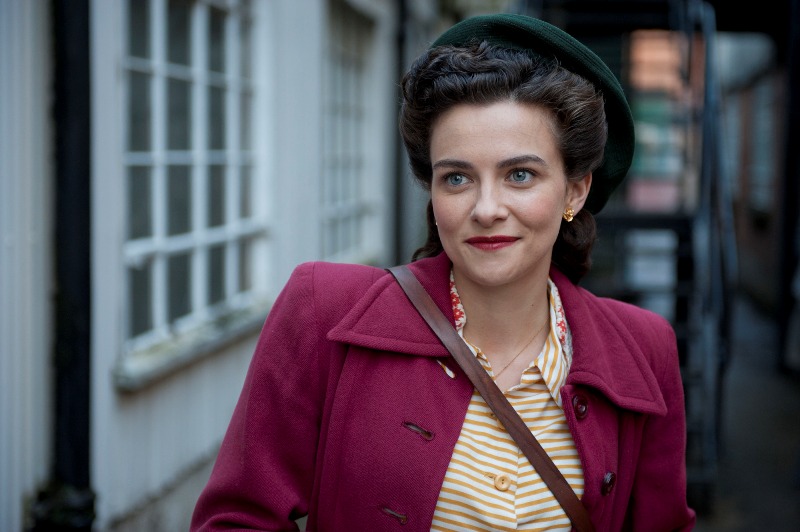 Meanwhile, somewhere in Whitehall, chaps with titles were struggling to pull the whole show together on a shoestring so as to avoid the humiliation of the Yanks stepping in - “rather as they had done in the war”, as one earl helpfully reminded another. A podgy meritocrat in the corner – name of Harold Wilson – suggested that there was “never a better opportunity to develop the tourist trade”. In a dangling subplot illustrating the austerity which gave its name to the ’48 Olympiad, an American oarsman lodging with Burnell’s old coach was treated to all the family’s meat ration, while Dickie’s mostly pointless Scottish fiancée (Sara Vickers, pictured above) treated him to a lunchpack of tripe-and-onion sandwich.
This was an embellished and half-remembered tale about meritocratic Britain’s postwar birth pangs. If parallels were quietly signposted between the London Games of then and now, some things about sporting dramas never change: the plot’s drive for the line consists of obstacles to be overcome, the impotent nailbiting of the supporters, the manipulative climax. The result was stirring but - unlike actual sport with its known unknowns - deeply unsurprising. Now let the real sitting down begin.









Add comment