Few anniversaries have got off to such a strong start in our current culture as that of the outbreak of the First World War. This new play by Peter Gill, which opened last night, is original in that it focuses not on the start of the conflict, or on life in the trenches, but on the end of the war — and the peace negotiations in Paris in 1919, which led to the Treaty of Versailles. But does it draw connections between that time, so long ago, and life in this country today?
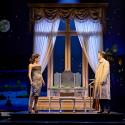
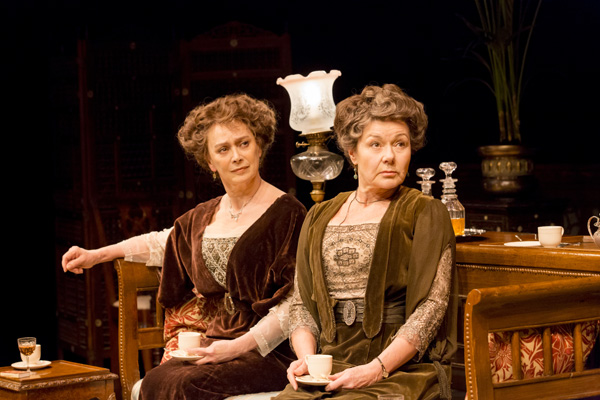
Act One and Act Three take place in the drawing room of the Rawlinson home in Kent. The atmosphere is positively Edwardian, with Persian carpets and an aspidistra plant. Mrs Edith Rawlinson, the matriarch, is serving tea to Mrs Marjorie Chater, her neighbour and friend. But while the Rawlinson children, Leonard and Mabel, have survived the Great War, Marjorie’s son Gerald hasn’t. This is a play about loss.
The older generation believe in Victorian valuesThe older generation, not only Edith and Marjorie, but also Geoffrey Ainsworth, a local backwoods Tory who defies stereotype, all believe in a form of Victorian values, in Britain’s Empire and in the purity of the English race. By contrast, the younger generation — Leonard, his sister Mabel and her friend Constance — are much more modern. They believe in female suffrage, universal democracy and in the self-determination of nations. This is a play about ideas.
Leonard is part of the British delegation being sent to France to draw up the peace treaty to end the war to end all wars. This is his chance to put his liberal ideas into practice. But the most radical voice of all is that of a dead man, Gerald, who quickly turns out to have been Leonard’s lover. This is a play about love. When his ghost appears to Leonard, Gerald — who acts as the story’s conscience — articulates the profound disillusionment of the lost generation.
Act Two of the play takes place in Paris, as Leonard struggles to help the British peace delegation create a just settlement. But political expediency always trumps his rational and economic arguments about not squeezing Germany until the pips squeak. Although the issue under discussion is an obscure one — the disputed Saar coal-producing region on the border between France and Germany — it symbolises all the other border disputes of that time, from Poland and Czechoslovakia to the Middle East and the Arabian Peninsular (whose oil is a nod to today's politics).
 The Saar dispute is also symbol of the economic irrationality of capitalism, and connections are made between the German coal industry and Britain’s coal industry. Gradually, it emerges that the peace treaty of the Great War doesn’t have a chance of succeeding because it uses the same tools that caused the conflict in the first place. Of course, Gill is much more subtle than this crude summary suggests and the play is a small masterpiece of detailed naturalism, a kind of Shavian state-of-the-nation piece, with a gay heart.
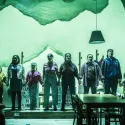
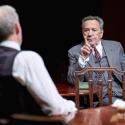
Gill directs his play with passionate integrity, and his cast is neatly organised into pairs: it is led by outstanding performances by Gwilym Lee and Tom Hughes as Leonard and Gerald. Then there’s Francesca Annis and Barbara Flynn (pictured above) as Edith and Marjorie, sometimes offering the Edwardian view of life, sometimes providing comic relief. As Mabel and Constance, Tamla Kari and Helen Bradbury are excellent, as is Adrian Lukis as Geoffrey the cultured Tory. And that’s only half of a large cast.
But although Versailles is perfectly balanced between the personal and the political, the huge amount of detail, the large amount of characters and the piles of incidental details make this a long three-hour evening. At times the piece lacks focus, at other times it gets bogged down in irrelevancies, and while the struggle of the main protagonists for articulacy is long and hard, it is also wearying. Perhaps the end of the First World War deserves such a thorough treatment, but that doesn’t make this an easy watch. Nor a particularly relevant one.