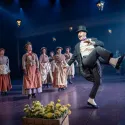
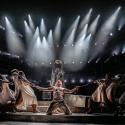
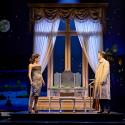
Who is Sappho? What is she? Not much is known about the influential Greek poet who was born some 2500 years ago. Her poetry was celebrated during her lifetime, but very little has survived. Those fragments that do exist speak of love, passion and longing. Her name lives on, not just because of her poetry, but because both she and Lesbos, the island she lived on, have given their name to the love of one woman for another. And so Wendy Beckett’s glitzy, short comedy celebrates the life of the poet through the prism of gay love today.
Although most of the cast are dressed in Greek tunics of the classical era (rarely a good look), Halcyon Pratt’s shiny set is more 1980s disco than baked Greek island. Silver streamers hang at the back, coloured lights spin, and two silver circles sit on poles either side of the stage, presumably alluding to the symbols for women. Alongside references to Greek philosophers and gods, the text is peppered with contemporary allusions, from the right of women safely to walk the streets at night, to the corrupt elite’s desire for small government and even smaller taxes. There is even a mention of Rwanda.
 That so little is known of Sappho’s life gives Beckett a free hand as she imagines that the poet is called upon to marry the young son of an elite family. Her parents are convinced that they, too, will join the elite once Sappho is married, and that their elevated status will enable them to establish a democracy and rescue the inhabitants of Lesbos from their downtrodden, debt-ridden existence. It’s never quite clear how they think they will achieve that, or even why it is on the agenda. In any case, Sappho, who has been smitten by the sight of a young woman, Adore, dancing in front of her window, is understandably not keen. Should she follow her heart, or act for the common good?
The play draws upon dance and appealing, Greek-inflected music composed by Mehdi Bourayou, and even has a traditional Greek chorus. They observe the action, flirt with Sappho, and play the hard-done-by Lesbos citizens. Eleanor Kane as Adore dances to entrance, her seductive moves enhanced by a mischievous sense of humour. Fotis Diamantopoulos’s choreography is enjoyable throughout.
The play was first staged, translated into Greek, on the island of Hydra in 2022. The cast here is new, but too often seems to adopt a style more suited to reaching the back of a Greek amphitheatre than the modest few rows at the Southwark Playhouse. In particular, Emmanuel Akwafo, who was so endearing as Pitch in the original cast of For Black Boys…, is outrageously over the top as the Narrator. Wriggling his hips and flouncing across the stage in high heels, he offers a link between now and then but delivers his lines in such a squeaky, contorted fashion that it can be difficult to hear what he is saying. The disputes between Sappho’s parents and those of her fiancé’s also feel overdone and over loud.
At least their noisy squabbling creates a striking contrast with the intensity and stillness of Georgie Fellows’s performance as Sappho as she frets over the restrictions on women. She is bowled over by sexual desire for Adore, and stresses the importance of individual love, just as her poetry celebrated love in contrast to the heroics of the much earlier Homer. "What is poetry without love?" Sappho demands.
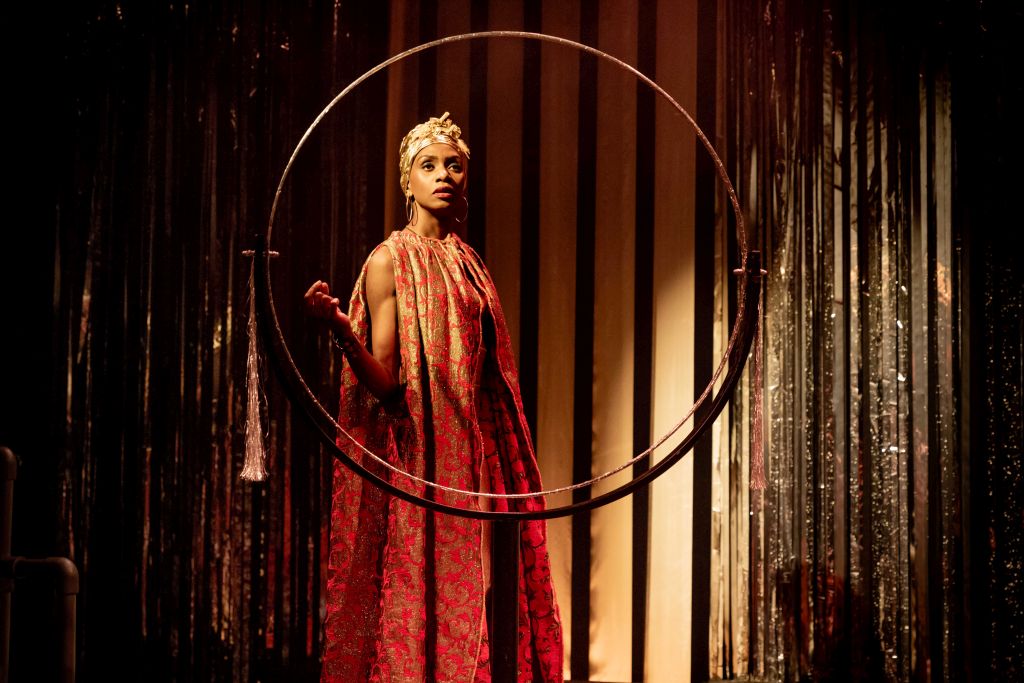
On hearing that Adore is already betrothed, Sappho staggers between promiscuity and attempted suicide, finally calling for the help of Aphrodite, the god of love, with a famous ode. But you can never rely on the gods. Basking in her own beauty and dressed in a dazzling gold body suit, Velile Tshabalala (pictured above) as Aphrodite is far too self-obsessed to offer much sympathy, although she does hint at a happy ending.
As a rainbow lights up the stage at the end, Beckett’s own song "Oh the Ladies" is heard, celebrating the right of people to follow their hearts. A committed company throws itself energetically into the task of telling Sappho's story under the direction of Beckett and Adam Fitzgerald. But all too often one is reminded of a classics department letting its hair down in an end of term revue.