

It was the best and worst of years for English National Opera. Best, because principals, chorus and orchestra seem united in acclaiming their Music Director of 14 months, Mark Wigglesworth, for his work at a level most had only dreamed of (“from the bottom up,” said a cellist, contrasting it with the top-down approach of predecessor Edward Gardner). Worst, because he stayed true to his principle of only working with a full-time company, and when the chorus unexpectedly accepted a nine-month contract, announced his departure.
opera reviews
David Nice

Fiftysomething may well be the new 32, the age Strauss and Hofmannsthal made the central figure of the Marschallin in their "comedy for music" Der Rosenkavalier. Hearts and minds no doubt still move with Renée Fleming, senior doyenne of the role in Robert Carsen's Royal Opera production, but she is mirroring her character in bowing out gracefully to the next generation, and fellow American Rachel Willis-Sørensen is clearly the new Princess Werdenberg on the Viennese block.
alexandra.coghlan

Der Rosenkavalier is an opera of thresholds. Characters are caught between states – girlhood and marriage, lover and lover-no-more, woman and whatever lies beyond sexuality and desirability – while around them a city and a nation are also poised on the brink, blocking out the noisy winds of change with waltzes that swirl ever more urgently through parquet ballrooms and gilded staterooms. Doorways give way to doorways in Robert Carsen’s new production of the opera, drawing the eye endlessly forwards, though without ever revealing what really lies ahead.
David Nice

Second and third times lucky: after the migraine-inducing multimedia overload of Peter Sellars's premiere production of El Niño, first seen in London in 2003 and subsequently excoriated in eloquent prose by the composer himself, John Adams's layered masterpiece has had two further performances here proving that the drama is all in the music. Vladimir Jurowski's 2013 Festival Hall interpretation literally had the edge, in its razor-sharp focus, on last night. But it's always good to see the composer as conductor make light of his rhythmic complexity as he nears his 70th birthday, and we also got to hear three stunning soloists fresh to the work.
As the title implies, there is the natural violence embodied in the storms of an unpredictable phenomenon as well as the ambiguous birth, to pain and to glory, of a special child ("niño" in Spanish). In one of the carefully selected Gospel texts, Joseph asks Mary why she weeps one moment and laughs the next. She tells him: "it is because I see two peoples with my eyes, the one weeping and mourning, the other rejoicing and glad". That duality makes this an apt nativity story to embrace at the end of 2016 (in one of the little spoken prefaces at which he's become so good, Adams imagined Herod today tweeting at 3am his loaded wish to be led to the infant Jesus).
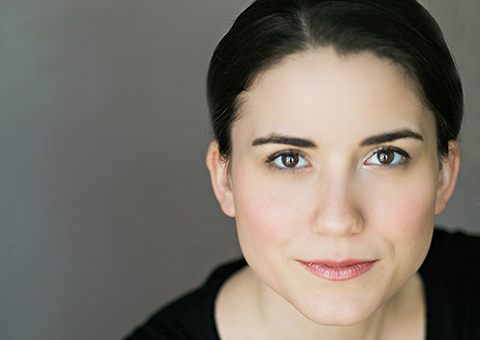 The most vivid bearer of the two sides, apart from the orchestra, is the soprano soloist. The music was written to showcase Dawn Upshaw's girl-next-door radiance as Mary up to the birth and her new-found (in 2000) ability to twist the expressive knife in the most shattering and musically complex number of Part Two, the climactic setting of poet Rosario Castellanos's bitterly ironic "Memorial de Tlatelolco", Adams's "slaughter of the innocents" enshrined in the hushed-up 1968 massacre of Mexican students. If Joélle Harvey (pictured above by Arielle Doneson) couldn't quite emulate Upshaw's cutting edge here, her devotion and emotion were total, and her youthful luminescence always shone (though I'm not quite sure why the three soloists needed the same amplification as the countertenor trio; except in big ensembles, Adams always keeps the orchestra down for them).
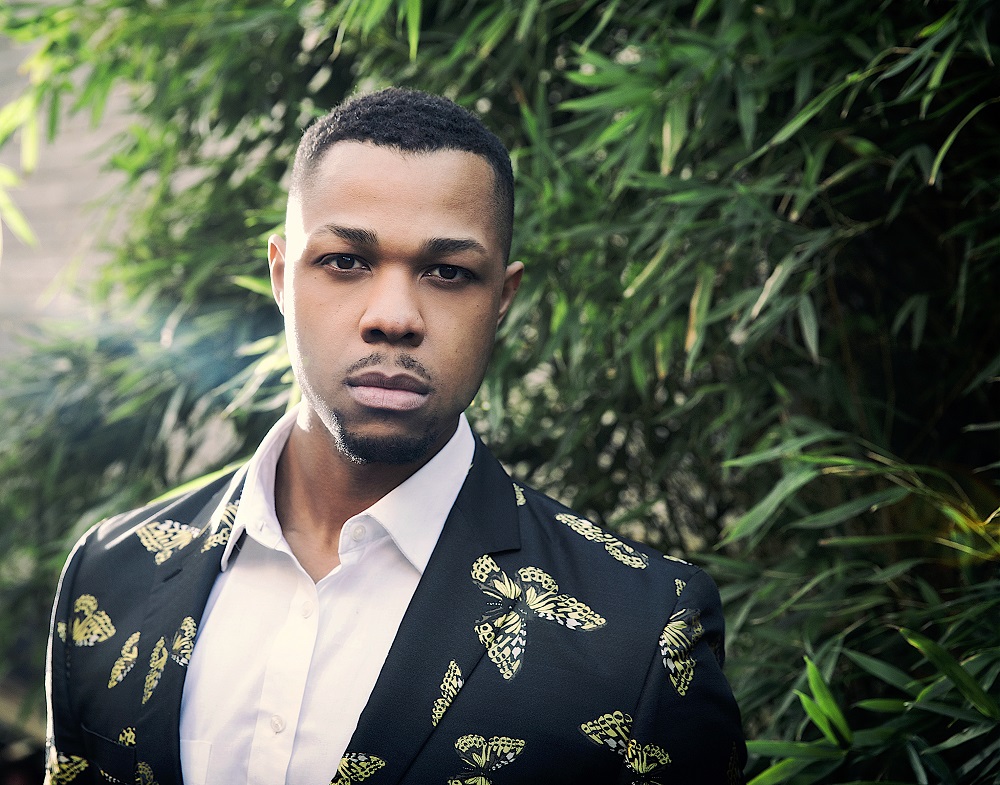
Castellanos is to El Niño what Wilfred Owen is to Britten's War Requiem, giving, along with fellow Mexican Sor Juana Inés de la Cruz, the Chilean Gabriela Mistral and Hildegard of Bingen, a much-needed feminine perspective to the wonder and terror of childbirth. She's a poet I'm immensely grateful to Adams and Sellars, his anthologist, for letting me discover. Mezzo Jennifer Johnson Cano couldn't quite banish memories of the late Lorraine Hunt Lieberson's superior sinuousness in the wonderful setting of "La Anunciación", Castellanos's vital female take on the mystery of conception and pregnancy, but later brought tears to the eyes with her part in the duet "Se habla de Gabriel" ("Speaking of Gabriel"). Hers is a magnificent instrument, as is the revelatory bass-baritone of Davóne Tines (pictured below): memorable in Joseph's anguished reproach "Mary, why did you do this?", shatteringly good in the high-lying ululations of "Shake the heavens", and deeply moving as Joseph sees everything in mankind and nature still at the moment of birth.
 Adams has a dependable group in countertenors Daniel Bubeck, Brian Cummings and Nathan Medley – memorable contributors to El Niño's even more complex if not quite as symmetrically perfect sequel The Gospel According to the Other Mary. At the one point where they step out as soloist Kings, Medley was quietly remarkable in the easeful switch between natural and falsetto registers. Adams's careful selection of instrumental colours to match brought forward amazingly expressive work from the LSO wind, while the brass helped to underline the mounting tension of Part Two and the violent snaps when the storm breaks. A professional choir might have given us more focus in quieter passages, but the London Symphony Chorus offered block shock in the apocalyptic moments. Who can ever forget, once heard, massed voices and snapping orchestra in the downward bending of "For with God no thing shall be impossible" from its D major brilliance?
And the London Youth Choir (all girls, from what I could see) played its part in the final miracle with real finesse. All that's been lacking from the richly shifting canvas have been the multiple voices of children. At the point in the numinous setting of the Gospel of Pseudo-Matthew, where the infant Jesus commands a palm tree to bend down its fruit for the refreshment of the refugee family and fountains pour out from the roots – eerie ascents to match the downward cascades from heaven of Part One – the young intone Castellanos's most simple and beautiful poem, "Una Palmera", ending with the simple word – voices in thirds, finally accompanied by one guitar only – "poesía" ("poetry"). It's the benediction we all need towards the end of a terrible year.
- Second LSO concert conducted by John Adams on Thursday 8 December
- David Nice's blog on further background to El Niño
- Read more classical reviews on theartsdesk
Next page: watch Davóne Tines sing 'Ol' Man River'
Robert Beale

With two of the biggest parts of the tetralogy already behind them, it might have seemed that Sir Mark Elder and the Hallé would aim simply at as near a perfect recording-cum-concert of Das Rheingold as possible, to get one more in the can and head for the final straight in a year or so’s time. But this Bridgewater Hall performance was more than that: a magisterial account of the score – done in one continuous take of two-and-three-quarter hours – and the recording based on it and its rehearsals, when it appears, will no doubt be a notable and probably great one.
David Nice

Having musicalised the madness in the method of Wilde's The Importance of Being Earnest, what would that wackiest of composers Gerald Barry turn to next? Why, dear child, what else but the method in madness of Lewis Carroll's Alice books. Except that method is mostly discarded in the shards of nonsense extracted from Carroll, and to be found only in the musical art of compression.
David Nice

Has there ever been a more pertinent time to revive the poetic mythologies of Brecht and Weill? The writer said that the good-life-for-dollars city of Mahagonny was not exclusively an American state of mind and should be set in any country where it's performed. But the inverted morality tale of The Seven Deadly Sins explicitly references seven American cities. And with lines like (in the Auden/Kallman translation) "If you show your offence at injustice, Mr Big will show he's offended", it's very much of the moment.
alexandra.coghlan

Most singers give recitals, and very nice they are too. But there are some – Bartoli, Florez, Netrebko, Terfel – who really put on a show. Mezzo Joyce DiDonato might just be the queen of this select band, and between the projections, smoke, sound effects, costume changes, lighting design and a solo dancer, her latest project throws down the gauntlet to any singer who thinks it’s enough just to learn the music and turn up in a clean frock.
Gavin Dixon

Jonathan Kent’s Manon Lescaut is back for a first revival at Covent Garden. It’s a gaudy affair, and seems calculated to provoke. But there are some interesting ideas here, and the musical standards remain high, even from the lesser-known names of this second-run cast.
Helen Wallace

“Not as a pleasurable play, but…an urgent message…” So composer Karl Amadeus Hartmann described his caustic chamber opera Simplicius Simplicissimus, receiving its UK premiere at Sadler’s Wells 81 years late. Five years before Brecht used the Thirty Years War for Mother Courage, Hartmann found in its orgy of brutality a resonance with the rise of National Socialism. His libretto sets part of Grimmelshausen’s 17th-century picaresque tale of a holy fool whose innocence protects him in a world of mercenary violence.