

Gangland London has never really worked for British directors. The warped poetry and seedy glamour of the American Mafia were the making of Coppola and Scorsese. You don’t get a lot of that down Bethnal Green way. Just knuckle dusters and glottal stops. But what happens if an American has a go at the Krays instead?
film reviews
Jasper Rees

The Bourne trilogy riffed on the idea of an undercover CIA operative who is so thoroughly brainwashed he no longer knows who he is. American Ultra mines that same scenario for laughs. Where Matt Damon looked the part, the weedy Jesse Eisenberg is very far from central casting. Indeed, nothing in his career so far has suggested that he could punch his way out of a paper bag.
That includes the film’s opening scenes, which position Mike as a geeky stoner working the till at a convenience store in the fictional Liman, West Virginia. His girlfriend Phoebe (Kristen Stewart) is the competent one who rescues the omelette from burning, owns quite a nice Subaru and fields his constant apologies. Then one night he gets mugged by two armed thugs. Without an idea how, he dispatches both in a trice and is soon banged up by the sheriff. More killers arrive and this time Mike needs a little longer to do them in.
 Meanwhile at CIA headquarters a turf spat has broken out between Mike’s former handler Lasseter (Connie Britton, pictured) and her preppy younger boss Yates (Topher Grace), who has decided to flex his muscles by wiping out her sleeper agent, the only success of a programme to train up mental patients as government assassins.
The script by Max Landis has a twist or two along the way, including a nice reveal about Phoebe that gives Stewart more to do than look on admiringly as Eisenberg lays waste to all-comers. “You’re his girlfriend, his mom, his maid and now you’re his lawyer?” says the cop when she advises him under arrest. Maybe that’s not all she is.
The film crescendos into a festival of splatty, splurgy cartoon violence: director Nima Nourizadeh has been hard at study of action genre tropes. Gore has not been this glorified in a comedy since James Gunn’s Super, in which a loser cast himself as a horribly vengeful superhero.
Are the laughs good enough to keep pace with all the punctured flesh? More or less. The joke of Mike’s incomprehension holds up reasonably well (“Is that a lyric?” he asks when greeted by a bafflingly coded message from Lasseter). Before he has accepted his destiny as a ruthless killer, Mike frets neurotically that he may be a robot. The best laughs are at the expense of the CIA, though there’s nothing to match the sheer bliss of Robert de Niro outwitting the Agency in Midnight Run. Eisenberg and Stewart are likeable, and there are fun cameos for John Leguizamo as a paranoid drug dealer who thinks he’s black and Bill Pullman as a national security capo. The film seems all set to cue up a sequel, but instead compresses it into the closing minutes. By then, the joke has done its job and run its course.
Overleaf: 'Piss My Pants' – watch a clip from American Ultra
Tom Birchenough

Any consideration of Iranian director Jafar Panahi’s Closed Curtain will inevitably be through the prism of how it was made, and the director’s current position in his native country. It’s his second work, after This Is Not a Film from 2011, to be made despite the 2010 prohibition from the Iranian authorities that (along with a range of other curtailments of his freedom) the director should not engage in cinema for a period of 20 years.
Tom Birchenough

Cartel Land opens with a group of crystal meth cooks at work somewhere in the dead-of-night Mexican wilderness. They boast about the quality of their goods: they have the best production equipment, and were even taught their expertise by a visiting American father-and-son team. They know the harm their drugs do, but what, they ask, are they going to do? They come from poverty. If life had gone another way, “We would be like you.”
Demetrios Matheou

The television series Downton Abbey and Upstairs, Downstairs, along with Robert Atman’s film Gosford Park, notably illustrate the public’s continued fascination with the relation between masters, mistresses and their servants. Yet none of them, not even the Altman, charted that relation with quite as much complexity and ferocity as Strindberg’s Miss Julie, in which no-one emerges well from the class struggle.
Written in 1888, the play represented Strindberg’s attempt to bring a new degree of naturalism to theatre. Its style and psychological acuity lend itself well to cinema; though being a chamber piece with just three characters and a single setting are theatrical constraints which any film adaptation must confront. Sadly Liv Ullmann’s new film singularly fails to do so.
Plays don’t have to be “opened out”, but it helps. Cinema’s greatest Miss Julie is Swedish director (and in some ways Bergman mentor) Alf Sjöberg’s 1951 version, which is visually arresting and offers a full-blooded view of the society in which Miss Julie and her father’s valet Jean conduct their class and gender battle of wits.
Rarely has the indoctrination of social position been so disturbingly depicted Mike Figgis’s 1999 version kept the focus on the protagonists, offering little more than a mobile camera to make it cinematic, and paid the price. Ullmann does even less, using mostly static medium shots, her filming of the drama as stiff and airless as it’s possible to be. And that’s a shame, because the actors really do go for it.
The action has been transposed to the Ireland of 1890, with Miss Julie now the daughter of an English baron (if I’ve gauged Chastain’s not wholly convincing accent correctly), which adds another layer of discord between mistress and servant.
She is the lonely child of the house, her mother dead, her father away, left alone with the staff as it makes merry on Midsummer Night. She’s lofty, vain and disdainful of her servants, at one point insisting that John (Farrell) kiss her boots, and rudely dismissive of his engagement to the cook, Kathleen (Samantha Morton), as she insists on dancing with the valet. For his part, John is a preening ladies’ man and social climber, and like Julie proud, manipulative and fundamentally weak. They’re birds of a feather, you might say; but in their dangerous game, it’s Julie who's the most vulnerable.
The story is constructed as a seesaw of power between the two, which could also be regarded as a struggle of two halves – before and after they have sex, both of them thrown out of kilter by this ultimate breach of their social contract. Aside from Julie’s personal tragedy, it’s the degree to which the characters are governed by class, status and money that is the meat and drink of the piece. Rarely has the indoctrination of social position been so disturbingly depicted, as when John admits that the very presence of the Baron on the other end of the bell gives him no choice but to defer, and serve.
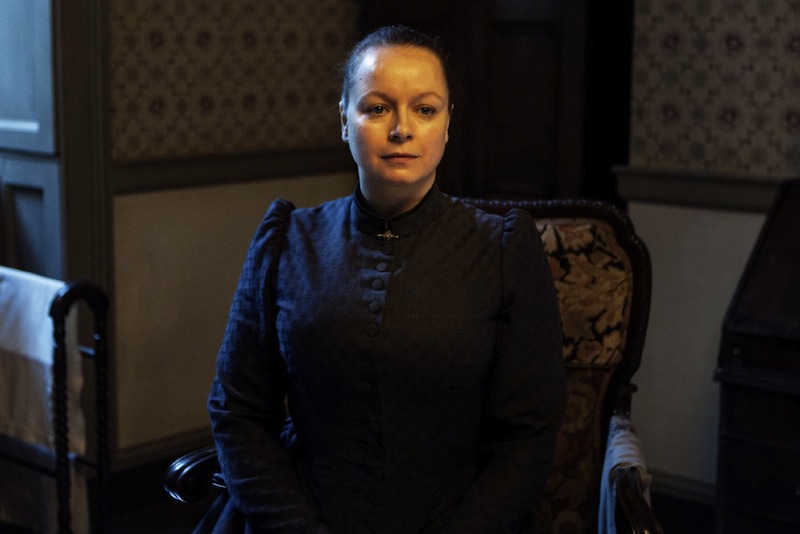 Standing between Julie’s self-destructive desire to “fall” and John’s vainglorious dreams of a life spending her money, it’s Kathleen (played with a compelling stoutness of character by Morton, pictured right) who is the most comfortable with her standing, chiding the others for stepping outside their boundaries. In a brilliant put down, she informs John that she’d only be jealous of him if he’d dallied with one of the other servants.
The class aspects are well presented, then. But there are two problems with the film. One is the direction, whose faults include too few external shots, no other characters and no attempt to present the world in which the action takes place. Farrell is made to constantly pace up and down vast interiors in a way that is repetitive and wearing, while the constant light outside the windows – even given that this is the longest day of the year – counteracts the idea that we are watching seething passions play out over the course of a sultry night; and that simply underlines the theatrical origins of the piece.
The other issue is that Chastain’s performance feels too skittish, if not a little mad straight out of the blocks, playing into the hands of Strindberg’s chauvinistic portrait of Julie, rather than challenging it; certainly, the character doesn't travel quite the distance that she might.
Nonetheless, with her red hair, pale skin and a nervous alertness in her eyes, the actress is extremely watchable; her doomed coquette makes me want to see her play Blanche DuBois. Farrell, on a good run of form that includes his conflicted cop in True Detective and in the up-coming, gloriously odd sci-fi The Lobster, has his machinating John turn on a dime – with those famous eyebrows working overtime – in a way that’s quite chilling. It speaks volumes that the film is simply too staid to contain the energy of their performances.
Overleaf: watch the trailer for Miss Julie
Jasper Rees

“I can hardly be cross with something that happened before we existed.” Andrew Haigh is a two-hand specialist intrigued by the space between lovers. His much praised debut Weekend told of two young homosexuals getting to know each other on a Saturday and a Sunday. In 45 Years, based on a story by David Constantine, he has shuffled the deck. The question of retrospective jealousy is the spark for a quietly devastating portrait of two old heterosexuals getting to unknow each other between a Monday and a Friday.
Kieron Tyler

En Équilibre addresses the impact of disabling and irreparable injury, thwarted ambitions, the questionable practices of insurers, and the connection between two dissimilar, yet both frustrated, characters. Despite its different strands, the film adeptly draws them together into a coherent and unexpectedly enthralling whole.
Matt Wolf

London property prices could well plummet, not to mention James Franco's ever-wayward career, if enough people see Good People, a staggeringly inept London-set gorefest that casts James Franco as an expat London property developer and Kate Hudson as his schoolteacher-wife who likes buying major appliances for friends as gifts.
Demetrios Matheou

A few months ago I saw a documentary called Ming of Harlem: Twenty-One Storeys in the Air, about a man who kept a tiger and an alligator as pets in his tiny New York apartment. It was a staggering thing to comprehend, not just because of the logistics involved, but the blithe cruelty in doing that to an animal, even a savage one. Then I saw The Wolfpack.
No, this doesn’t concern cruelty to wolves, but to children, and not just any children, but a man’s own. I’m beginning to wonder what they put in the water in Manhattan.
Tom Birchenough

What’s it really like to be a dictator? Or president, if we put it more circumspectly, as Iranian director Mohsen Makhmalbaf does in his new film of that name – though this President clearly believes he’s of the “for-life” variety, if not even a rung higher given that the mode of address in this contemporary court is, “Your Majesty”.