

David Sington’s The Fear of 13 is many things – blisteringly immediate, compelling, emotionally devastating – but at times it may have you pondering whether it fits into any traditional “documentary” category.
film reviews
Matt Wolf

Maggie Smith is in her element as Miss S in the film version of Alan Bennett's 1999 play The Lady in the Van, her partnership with the playwright-actor one of the defining components of the storied career of the octogenarian dame, whose renown has leapt the decades due in no small part to the Harry Potter and Downton Abbey franchises.
Jasper Rees

A couple of years ago there was a television documentary about Steve Jobs which wafted much smoke up the sainted iHole. A variety of famous fanboys wept over the curve on the iPhone 3 and simpered at the kleptocratic takeover of the music industry. Never mind that Jobs was reportedly short of redeeming features. A documentary has no obligation to supply drama. A feature film is another story. The makers of Steve Jobs have their work cut out finding something plausibly nice to say about a driven egomaniac who tells anyone who’ll listen that he’s changing the planet.
Tom Birchenough

American director Sean Baker is an adept at exploring different Los Angeles worlds that we don’t often see portrayed in standard Hollywood fare. His much-acclaimed Starlet, from 2012, took us into the city’s porn industry (in an entirely non-judgmental way), ticking most of the boxes usually associated with “independent” cinema.
Graham Fuller

Saoirse Ronan, emerging decorously into womanliness in Brooklyn, deserves a stack of awards nominations for her portrayal of a brave young woman torn between her old life in Ireland and her new existence in 1952 New York's most vibrant borough. Restraining her character’s flickers of doubt, culpability, satisfaction, and pleasure, Ronan shows how the maturation of Eilis Lacey – from seasick voyager and homesick immigrant to serene resident – is attributable to her hard-won stoicism and quiet determination.
David Kettle

Sometimes it’s visual art with a sonic slant; sometimes it’s music with a visual slant. Glasgow’s Sonica – created by producers Cryptic, now in its third year and bigger than ever – feels like a thoroughly modern festival, defying genre boundaries and instead focusing squarely on the intersection of the sonic and the visual. That might make some of its offerings hard to categorise, but there’s nothing wrong with that.
Tom Birchenough

Taxi Tehran is Iranian director Jafar Panahi’s third film since the 2010 prohibition that, among other restrictions, forbade him from working in cinema for 20 years. While its very existence may count as an achievement in itself, much more importantly it’s also a lovingly cheeky riposte to those who have restricted his freedom of thought (and movement), as well as a reflection on narrative and how it is created.
Adam Sweeting

To create this strikingly original portrait of the man some (though not Frank Sinatra) liked to call "the greatest movie actor of all time", writer/director Stevan Riley has plundered a remarkable trove of Brando's own audio recordings and used them to create a kind of self-narrating autobiography. The notion that we're hearing Brando telling his own story from some post-corporeal ether is reinforced by the device of opening the film with a computerised 3D talking head, based on a digital image of Brando's own head made in the 1980s.
Matt Wolf

As further proof that films in a lower-key can often land with the greatest impact, along comes Mississippi Grind, a casually mournful, beautifully made road movie that is perhaps best described as the picture that Robert Altman didn't live to make. A conscious throwback to the era of Altman's California Split, this latest from the writer-director team of Ryan Fleck and Anna Boden locates an almost Chekhovian melancholy in its portrait of two gambling men, drifters both, in search of an actual and metaphoric pay-off from life.
As unforced in its telling as the neatly arrived-at rapport between leading men Ryan Reynolds and the wonderful Ben Mendelsohn, the movie is likely to be swamped by bigger, noisier titles from every side, but its quiet virtues seem guaranteed to endure.
To be sure, the picaresque quality to the script may frustrate those who want more overt juice from a journey whose origins in an earlier celluloid age are directly referenced by the appearance of veteran director James Toback in a vivid cameo – Toback having written the 1974 Karel Reisz/James Caan film The Gambler that was recently remade (to poor reviews) with Mark Wahlberg in the lead. As was evident in the filmmakers' previous collaboration, Half Nelson, which brought Ryan Gosling a 2007 Oscar nod, Boden and Fleck prefer gently inflected observation to manufactured Big Moments, and the results are all the better for it.
Gerry (Mendelsohn, sporting not a trace of his native Australian accent) and Curtis (Reynolds) enter one another's lives at a poker table in Dubuque, the American economy being debated on TV in the background while the two men attempt to boost their own personal fortunes. Before long, their easeful banter finds them taking off together for a drive south to New Orleans, their need to re-connect representing the highest stakes of all. 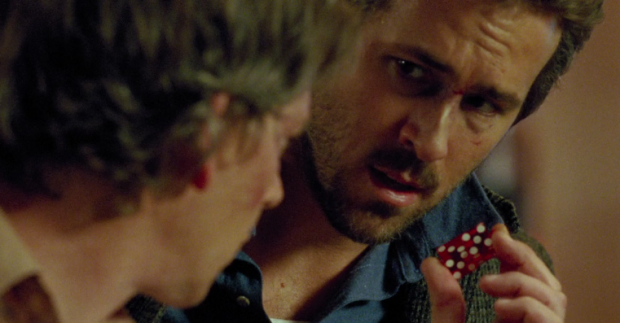 The pair's route lead them towards various women who have figured in their lives, among whom Robin Weigert stands out as the inevitably cautious mother of a daughter whom ex-husband Gerry says is seven – or maybe six: significantly, her father isn't quite sure which it is. Nor are facts, one senses, as important as the feeling the men come to share that they might in fact be talismanic for one another, Gerry admiring Curtis's unexpected emergence in his life as "a big handsome leprechaun", which isn't a bad way of characterising this underrated actor's allure.
Is their car ride an emblem of freedom or escape – are they merely absolving themselves of social obligations by flooring the accelerator and leaving the responsibilities that come with adulthood behind? Mississippi Grind to its credit doesn't cast judgement. Instead, it allows the actors to draw their own complete, composite portraits of a pair for whom the necessary posturing that comes with gambling only goes so far. "I'm not a good person," Gerry tells Curtis, Mendelsohn turning suddenly sad-eyed as if to suggest a cumulative regret he will never be able to voice. The film may take its title from a horse at the racetrack that may or may not be a good bet, but when it comes to gradually laying bare a character's inner life, Mendelsohn really does rank among the best.
Overleaf: watch the trailer for Mississippi Grind
Adam Sweeting

The title sequence of Bond number 24 is a bit of a nightmare, with Sam Smith's mawkishly insipid theme song playing over a queasy title sequence featuring a hideous giant octopus, but the traditional opening mini-movie is an explosive chain reaction which doesn't disappoint. This takes us to Mexico City on the Day of the Dead, where Daniel Craig's ghoulishly attired Bond is on a mission to take out a chap called Sciarra.