

When An Inconvenient Truth won the best documentary Oscar 10 years ago, the film’s success marked two significant events: a positive turning point in the campaign to avert environmental catastrophe; and the resurrection of the public career of Al Gore, after his presidential defeat at the ha
film reviews
Saskia Baron

No cliché is left unturned in this odd-couple action comedy. Ryan Reynolds and Samuel L Jackson are the salt ‘n’ pepper rival bad-boys on the run. Cue shoot outs and high-speed vehicle chases through assorted European cities, interspersed with routine bouts of mutually insulting dialogue before bromance blossoms. Come back, Eddie Murphy/Nick Nolte, Chris Rock/Anthony Hopkins, Will Smith/Tommy Lee Jones, Mel Gibson/Danny Glover, all is forgiven.
Ryan Reynolds plays Michael Bryce, a professional bodyguard who loses his élite status when a wealthy client is taken out by a mystery sniper on his watch – this is shortly after we’ve endured a split-screen, pre-title sequence composed of men’s magazine lifestyle-porn shots of Bryce's modernist glass house, foam-packed cases of armaments and special edition Jaguar.
Who knew it was so difficult to shoot a man driving a powerboat on a straight canal?
Reduced professionally to escorting a cocaine-crazed exec (Richard E Grant) out of a London office just before it explodes, Bryce is then enlisted by ex-lover and Interpol agent Amelia (Elodie Jung) into protecting professional hitman, Darius Kincaid (Samuel L Jackson) from Manchester to the Hague where he’s needed as a witness in the war crimes trial of Dukhovich, an evil Belarus dictator (Gary Oldman). Dukhovich has sent hitmen to terminate Kincaid before he can get to the court. At this point, I found myself Ionging for the days when Gary Oldman did more than put on a dodgy eastern European accent and some prosthetics and was allowed to show his real acting chops.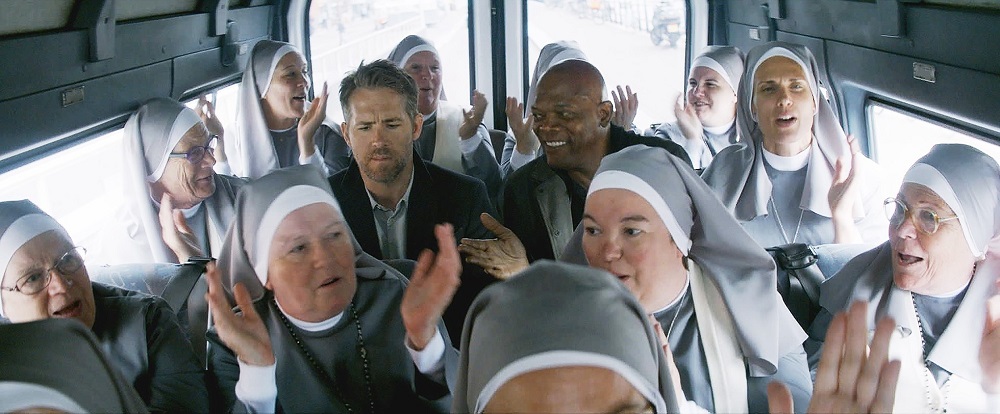 Throughout the film an iPod shuffle soundtrack is deployed drawn from the Grand Theft Auto playlist, turning every action sequence into an oh-so-ironic music video. Foreigner’s "I Want to Know What Love Is" plays out against slo-mo slaughter at a funeral (complete with flying canapés and corpses); grating heavy metal enhances torture by a tattooed henchman; Ram Jam’s version of "Black Betty" provides the earworm for a chain-choking scene in a hardware store. Unfortunately, in the wake of Baby Driver with its niftily executed marriage of music to action, The Hitman’s Bodyguard fails to hit any new beats.
The action scenes mimic Bond movies – aerial vistas of London and Amsterdam highlight tourist landmarks and there's much vaulting from buildings and ingenious vehicle swaps. It's a high-cost production but with odd moments of sloppiness in the CGI: among the many matted-in fireballs there's a dubious windmill just in case you missed out that our heroes are in Holland. There’s no shortage of hardware, explosions and eviscerated baddies but it’s all a bit baggy. An Amsterdam-set chase sequence goes on for so long (involving trams, motorbikes, 4WD and boats) that you almost feel sorry for Dukhovich who just can't seem to hire assassins who can aim. Who knew it was so difficult to shoot a man driving an open-topped powerboat on a straight strip of canal? 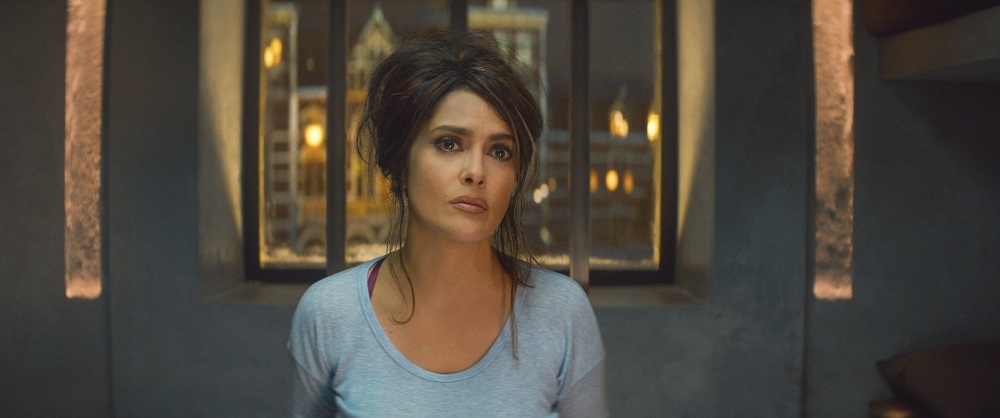 When not involved in chasing and shooting, the two leads settle down to lengthy exposition on their lives (cue a dirge-like flashback to formative childhood traumas designed to engender sympathy for Kincaid's career choice as paid killer). Our heroes debate their relative moral superiority: ‘Who is more wicked? He who kills the evil motherfuckers or he who protects them?’; but even more turgid is the endless banter about romance and Bryce's regrests about losing his Interpol sweetheart (Elodie Yung). After the umpteenth splurge of motherfuckery I had a craving for Jackson's character to meet up with Peter Capaldi's Malcolm Tucker from The Thick of It for a serious swear-off.
Salma Hayek is entertaining as Kincaid's sassy wife, locked up conveniently close to the Hague court so he can divert from the main action and impersonate the Milk Tray man delivering lovegifts. There’s some unintended amusement to be had in the odd casting of the two Interpol bosses – played by actors who could double as look-alikes for Katie Hopkins and Ilie Nastase – but a comedy scene hitchhiking with a van full of nuns is just painfully stupid. Both Jackson and Reynolds have given far better performances in similar roles; revisiting The Long Kiss Goodnight or Deadpool would make more rewarding viewing than shelling out for The Hitman’s Bodyguard.
Overleaf: watch the trailer for The Hitman's Bodyguard
Markie Robson-Scott

Christopher Rainey, aka "Quest" – his hip-hop name – lives with his wife Christine’a and their young daughter PJ in north Philadelphia.
Sarah Kent

I hate biopics about artists in which the portrayal of “genius” is hyped to the point where it becomes a ludicrous cliché. Although I appreciate that, as far as entertainment goes, seeing pigment brushed onto canvas is on a par with watching paint dry, I still can’t forgive directors who resort to dramatic extremes in the hope of evoking the tribulations of the creative process.
Markie Robson-Scott

A Ghost Story must be the first film with a sheet – a very expressive one – in the leading role. Beneath it is C (Casey Affleck), with two holes for eyes. It’s funny at first, but the Halloween cliché is rapidly transcended. C, a musician, haunts the faded ranch house in Texas where he lived with his wife M (Rooney Mara) before his death in a car crash nearby.
Tom Birchenough

Finnish director Dome Karukoski has made a sympathetic and quietly stylish biopic of Touko Laaksonen, the artist who did as much as anyone to define 20th century male gay visual culture. There’s a degree of irony in the fact that we know him by his national pseudonym – he started signing his work “Tom” for anonymity, while “of Finland” was thought up by an American publisher – given that post-war Helsinki is depicted here as about as repressive an environment for a young man exploring his sexuality as could be imagined. Asked at one point whether he has published his work in his homeland, Laaksonen replies, without a trace of irony, that it would be more likely to appear in the Vatican.
Karukoski and screenwriter Aleksi Bardy give the film’s first half over to the artist’s early years, and it feels considerably more organic and contained than the second, which tells of Laaksonen’s discovery of, and by America. It opens with his military service in the Russo-Finnish war, when he first started cruising night-time parks; that resulted in unexpected comradeship with some of his fellow soldiers, as well as providing the origins of his visual iconography. Police repression, and the violence with which it was often associated, became somehow absorbed into his images of strong men, often in uniform. One particular wartime experience – a murderous encounter with a Russian parachutist – is given special significance: Laaksonen clearly came out of the war traumatised.
The film’s final scene movingly brings home the full trajectory of his journey
After the conflict ended, he shared a flat with younger sister Kaija (Jessica Grabowsky), also an artist, and life slowly began to look up. Laaksonen started to work in advertising, in due course becoming art director at a major agency. But the subjects he made his own – his trademark heavily muscled and phallused men in tight uniform and leather – had to be kept locked away. Even a trip to more progressive Berlin confirmed his anxieties.
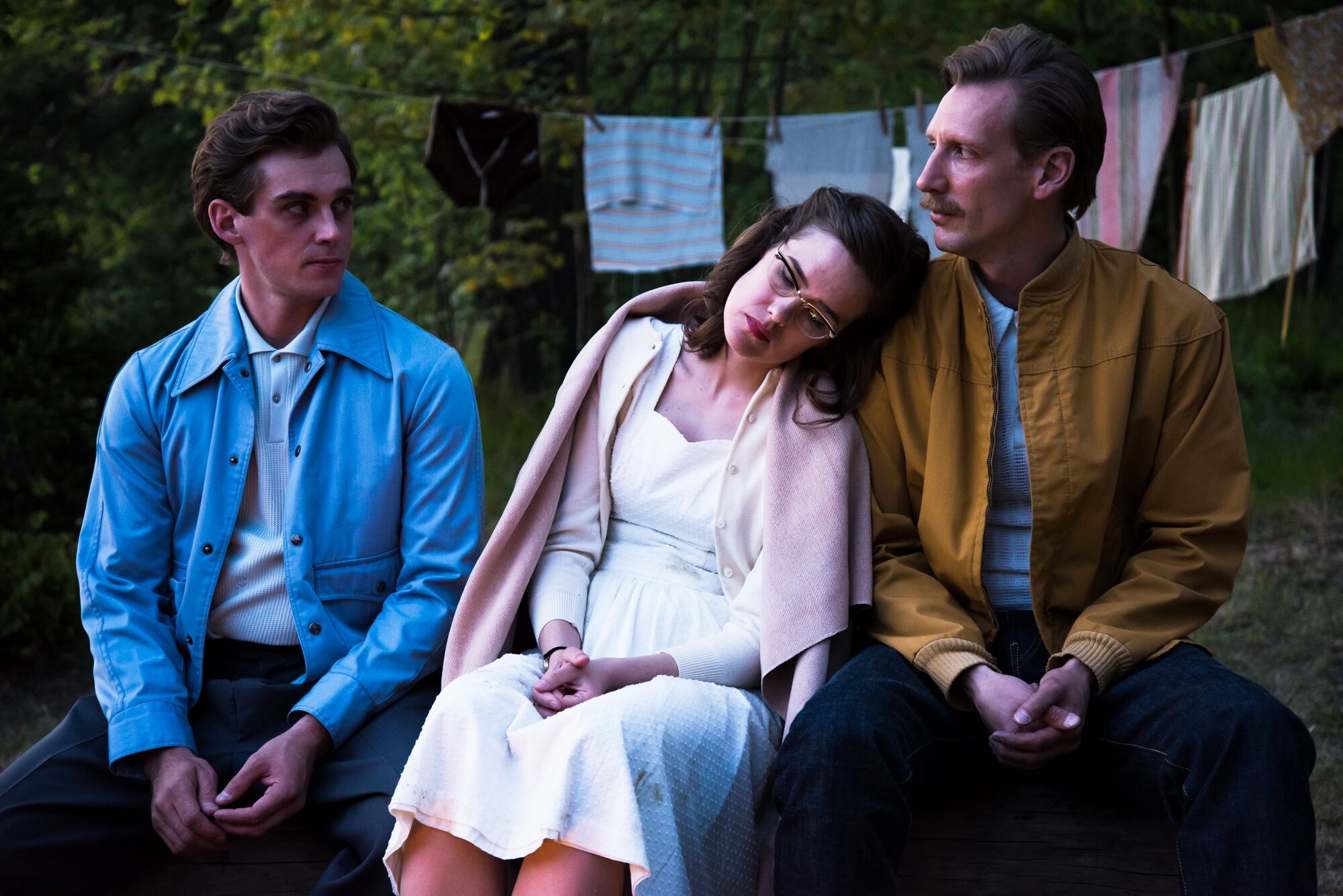
But the arrival, as the siblings’ lodger, of the beautiful Veli (Lauri Tilkanen), a dancer, slowly began to change Tom’s world – although Karukoski leaves the details of their relationship rather undeveloped – and gave him an increasing confidence in his work, which started to circulate among friends. His signature fetishisation began to include bikers. “We have started a motorcycle club, only without motorcycles,” he tells one old friend from the war years, with a new element of humour, even if such levity is qualified by the fact that the friend concerned has been disgraced after a police raid and is now in an asylum, determined to “cure” himself of his homosexual orientation. (Pictured below: from left, Lauri Tilkanen, Jessica Grabowsky, Pekka Strang)
 Designer Christian Olander portrays this dark Helsinki world through a palette of subdued colours, greys and blues (we only see the Finnish sun once, on a summer day out in the archipelago). Which also works just right in setting up the contrast to Tom’s first trip to California, with its bright colours and sheer enjoyment of physical beauty. First published in the mid-1950s in Physique Pictorial – the magazine was beginning to fascinate David Hockney at about the same time – the artist’s work was initiating a whole style of American gay life, one that, it feels, left Laaksonen himself with some catching up to do. He had, in every sense, arrived in another world.
Along the way Karukoski rather jumbles his timeline, virtually skipping a decade or so, but it doesn’t detract from the whole. There’s definite digression in the director expanding his story to include Laaksonen’s first American fan, and later close friend Doug (Seumas Sargent) with unlinked episodes from his life. The closing of Tom’s Helsinki life is dealt with somewhat perfunctorily, especially in his relation to his sister Kaija who either has or hasn’t – it’s never quite clear – understood all along what was going on in her brother’s life. The onset of AIDS in the 1980s, which brought a backlash against Tom’s art, is rather unconvincingly set against an all too obvious feel-good plot diversion.
But for viewers sympathetic to the film’s subject – and Karukoski has made a sufficiently mainstream film for that number to include a considerably wider audience than might be expected – all that will seem carping. Pekka Strang turns in a very accomplished performance as Tom, as convincing at the age of 20 as at 70, with a certain haggard, occasionally uneasy distraction that seems particularly fitting for the early years. The film’s final scene movingly brings home the full trajectory of his journey – how, out of the pain and isolation of his early years, he created and helped to define a subculture that became emblematic for so many gay men the world over. It will be a stony-hearted viewer indeed who resists the celebration of Tom of Finland’s conclusion.
- Read more film reviews on theartsdesk
- Overleaf: watch the trailer for Tom of Finland
Markie Robson-Scott

When you’re next strolling through Washington Square Park, or SoHo, or the West Village, you can thank Jane Jacobs that those New York neighbourhoods have survived (though she'd blanch at the price of real estate). Four-lane highways almost dissected and ruined them in the mid-Fifties, but her grass-roots activism saved those higgledy-piggledy streets.
Nick Hasted

Bowie’s “Cat People (Putting Out Fire)” plays as Charlize Theron’s Lorraine Broughton makes her entrance. She’s the last Cold War super-spy, a female Bond sent to Berlin as the Wall crumbles. “Killer Queen”, prominent on early trailers, would have done just as well. Daniel Craig in Casino Royale is the last time an action star made such a startling bow.
Matt Wolf

Saskia Baron

Valerian and the City of a Thousand Planets starts promisingly: there’s Bowie’s Space Oddity on the soundtrack (a bit clichéd but evocative) and a sly montage of personnel handovers at an international space station over the decades. Astronauts from different earthly nations are superseded by increasingly awkward and funny encounters between human astronauts and phantasmagorical creatures arriving for their tour of duty – which alien protuberance will include an approximate hand to shake?