A friend of mine has an Eames lounge chair that he treats with enormous reverence and claims is the comfiest seat ever made. I simply don’t get it; with its bent plywood shell and black leather upholstery, this 1956 American design classic looks to me dark, clumsy and uninviting – especially when compared with Eileen Gray’s Bibendum chair of some 50 years earlier or the delicate designs produced in the 1920s for the Bauhaus by Le Corbusier, Marcel Breuer and Mies van der Rohe.
Since the Eames phenomenon didn’t readily cross the Atlantic and we are not overly familiar with their achievements, this fascinating film come as something of a revelation. It brings to vivid life the story of how Charles, “an architecture school drop-out who never got his licence” and Ray, an abstract painter who studied with Hans Hofmann, “gave shape to America’s 20th century".
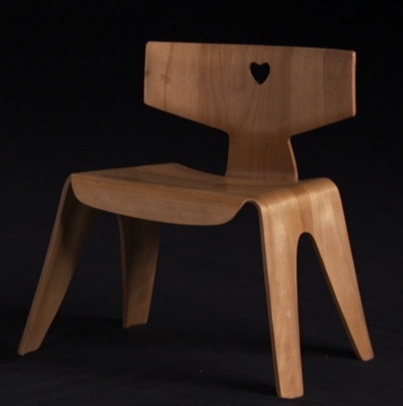 “We don’t do art,” the couple said, “we solve problems.” Their ambition was to design good quality furniture that everyone could afford or, as they put it, “to make the best for the most, for the least” and, in the 36 years they worked together, they designed over 40 chairs (pictured right, Plywood dining chair, 1946) many of which are still in production by the Herman Miller Company.
Their office in Venice Beach, California was, we learn, “one of the most creative addresses on earth”. Working there was obviously more a vocation than a job. Various employees reminisce about an office they liken to Disneyland, a Renaissance art workshop and a circus. Being there, recalls designer John Neuhart, “was a delicious agony… it was like a temple for me.” It was “a place where everyone was driven to work all the time – 24/7/365. Watching people at their desks was like watching people take their brains out and knead them like dough.”
The Eames collaboration began in 1942 when, having left his wife and baby, Charles took off with Ray for Los Angeles to embark on a creative partnership. The plan was to produce a plywood chair and, since there were no machines able to bend the wood, they rigged one up with heating coils and a bicycle pump; but there was a problem – the plywood splintered under pressure. While making plywood splints for the US military during the war, they discovered the answer – leaving gaps to release the tension – and so were able to produce what Time Magazine dubbed “the greatest design of the 20th century".
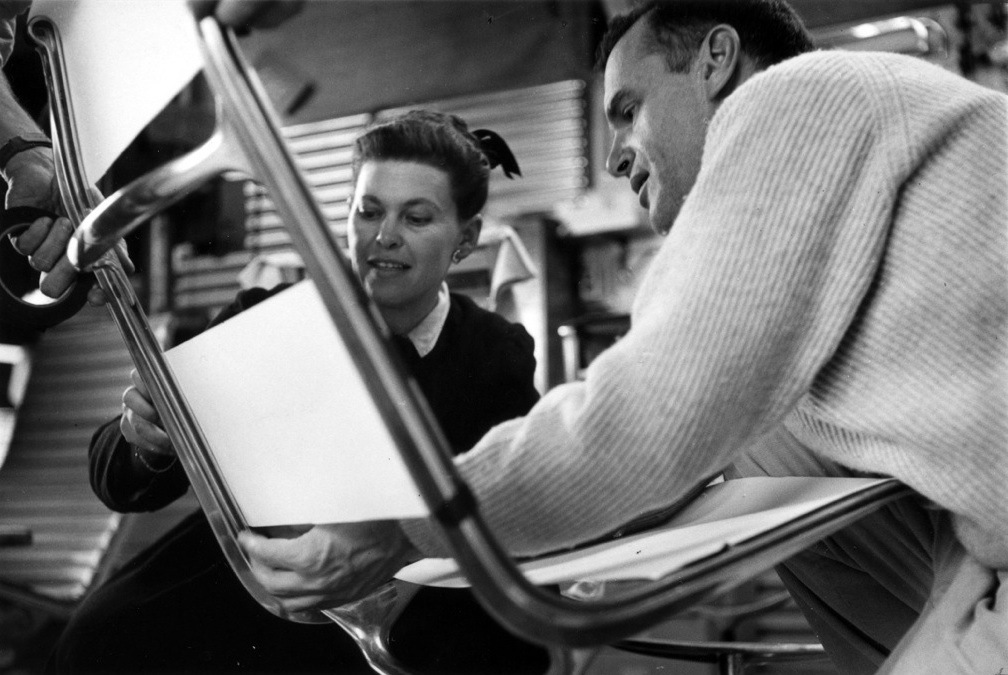 Later they added plastic, fibreglass and aluminium to their repertoire (pictured left, working on Aluminium Group Lounge Chair, 1957) and branched out into toys and textiles, photography, film, animation, and exhibition design. In 1959 at the height of the Cold War, they were commissioned to produce a film extolling the American way of life to a Russian audience. The outcome was a seven-screen eulogy beginning with shots of the night sky, encompassing everything from landscapes and cityscapes to cars, freeways, industry, architecture and family life and ending with a bouquet of forget-me-nots.
Their most famous film, Powers of Ten, from 1968, is a dizzying treatise on scale – from the macro to the micro – illustrated in factors of 10. A couple lies on a rug in a Chicago park. From a one-metre square overhead establishing short, the camera zooms out to a view 10 metres square, 100 metres square, 1,000 metres and so on, until finally we see the earth as a planet floating in space. Next we reverse back to the man’s hand and pass through his skin to dive into the subatomic realm.
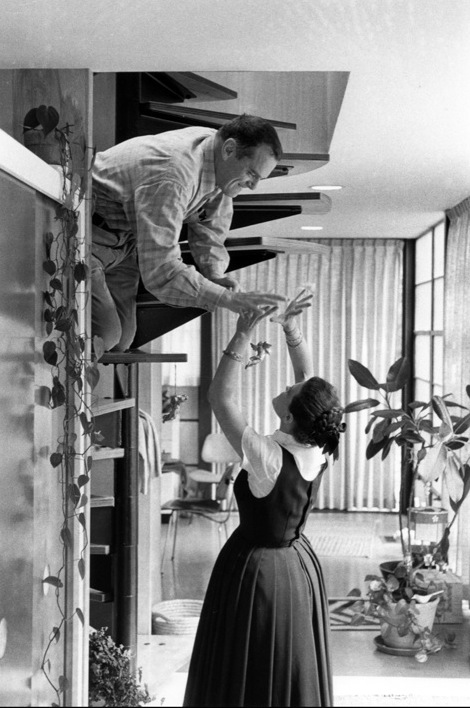 Eames: The Architect and the Painter is as much about the couple as their achievements, though, and the sexual politics of their relationship is fascinating at a time when women were supposedly wedded to the kitchen sink. “It was as if they were one individual with two different special areas,” recalls a friend. Yet in 1946, New York’s Museum of Modern Art gave Charles a one-man show and he took all the credit for their creations. In myriad photographs taken over the years, Ray appears behind Charles and in public she seems similarly to have taken a back seat. A clip from a television chat show says it all. The female presenter introduces Ray as “the woman behind the great man” and, from then on, addresses all her questions to Charles.
In the late 1950s the couple began making films for large corporations such as IBM and Westinghouse and, since Charles liaised with the chaps in the boardroom, Ray must have felt increasingly sidelined. She began to look dumpy and middle aged while, in contrast, Charles blossomed with the confidence of success.
He indulged in extramarital affairs and, a few years before his death, even prepared to close the West Coast office and open another in New York with art historian Judith Wechsler, whom he planned to marry. To her credit, Wechsler decided against destroying the marriage and Ray remained loyal to the end – even timing her death to coincide with the 10th anniversary, on 21 August 1988, of her husband’s demise.
When the Venice Beach office closed, 350,000 photos and 500,000 documents were shipped off to the Library of Congress for storage; but this well-researched and exhilarating film brings the Eames’ extraordinarily creative partnership to life in a way that a crate-load of documents never could.
Watch the trailer to Eames: The Architect and the Painter