Of Alexander Nikolayevich Scriabin, who died 100 years ago aged 43, it was said at one time (by Rimsky-Korsakov) that he was “warped, a poser and opinionated”, at another (by Boris Pasternak) that he could seem “as tranquil and lucent as God resting from his labours on the seventh day”. Only Pasternak’s definition applies to the magnificence of Garrick Ohlsson, a lion couchant who can use his wings to fly into the sun when Scriabin so requires. After five sonatas and 10 pregnant miniatures, including three encores, he seemed as calm and genial as when he’d begun, grinning in genuine delight at the many cheers.
There was much to celebrate here, despite the occasional dissonant gloom of Scriabin’s later style. After closing the orchestral year in unforgettably lucid might with Busoni’s 80-minute Piano Concerto, Ohlsson was back on Scriabin’s birthday – actually Christmas Day according to the Julian calendar operating in Russia back in 1872, so no wonder the composer developed Messianic tendencies.
The translucent, lovely side we heard in several heart-stopping modulations at the heart of the D flat major Étude, Op. 8 No. 10, in the lyric bliss minutes into the Second Sonata and above all in the syncopated Icarus flights at the ends of the Fourth and Fifth Sonatas. The fall came in the anguish of the Sixth, by which time in the programme we might have heard a bit too much already of what Prokofiev intelligently described as the “millstone round Scriabin’s neck” of his search for a new harmonic basis, “making it difficult for invention in the realm of melody and, chiefly, the movement of voices”.
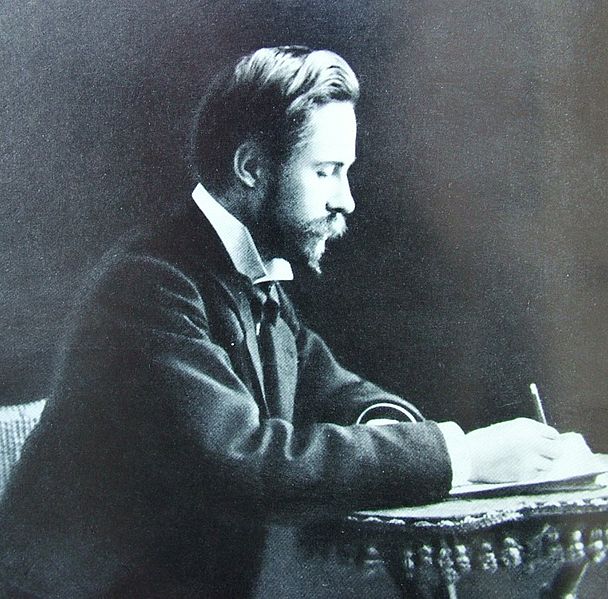 Still, in each new sonata up to the Tenth of 1913, there is always something fresh to drive Scriabin towards what we might think of as the abyss of atonality, but which he believed was a new synthetic religion (the composer, pictured right, in 1905). The metaphysics, not to mention the outlandish French score instructions – on the bottom line of the Sixth’s opening page we get “souffle mystérieux”, “onde caressante” and “concentré” – aren’t at the forefront of Ohlsson’s shining enlightenment. Rarely, even from the Russian school, has a more opulent, full orchestral sound been won – never forced – from from a piano. Ohlsson would fill the Albert Hall beautifully (how about two late-night Proms? I guess it’s too late to think of that now for anniversary year).
Always the ornamental flames are subsidiary to the main lines; fires blaze up from an especially vivid bass to the top of the range, astoundingly so in one firework towards the end of the Seventh (“White Mass”) Sonata, chord clusters never sound ugly and clarity is paramount even in the most gigantic washes of sound.
Though I feel, as I did in the Busoni Concerto, that Ohlsson is more a Prometheus than an Ariel in the music of the spheres, he is perfectly capable of pianissimo magic. Désir, the Scriabinesque mystery in a nutshell, was aphoristic perfection and even in the opening A minor Prelude, relative juvenilia, there was space enough to hear the kind of suspensions which would uproot tonality altogether in the later pieces. The gift to be simple and inward could not have been more poetically delivered than in the first of the three encores, the famous Étude Op. 2 No. 1 composed when Scriabin was only 15. What a strange journey he took after that, and how effortlessly Ohlsson seemed to embrace it all. The only problem was that I wanted his second instalment tonight, not in April, but I’ll just have to wait.
- Listen to this concert for the next month on the BBC Radio 3 iPlayer
- Ohlsson's second Scriabin programme is on 27 April (not available on the Wigmore website)
Next page: Ohlsson introduces three Scriabin piecesGarrick Ohlsson introduces three Scriabin pieces