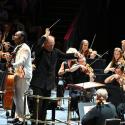
It could have been your standard Russian touring programme: Tchaikovsky ballet music as hors d'oeuvre, Rachmaninov piano concerto, Shostakovich symphony. But the symphony was hardly the usual (Sixth rather than Fifth or Tenth). And any chance should be taken to hear London-born Freddy Kempf, a phenomenal artist incapable of playing a routine phrase, on his relatively rare visits to his native city.
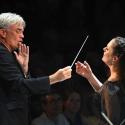
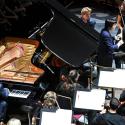
Kempf is a pianist in a million. At first you may wonder if the bucking and circling around the keyboard is absolutely necessary. But it produces the sound: the deep staccatos which highlight only the right notes, the incredible definition of Rachmaninov's inner filigree which emerges all the clearer for a refusal to use the sustaining pedal to blur the sound. And in this performance of the inevitable Second Piano Concerto, Kempf's watchfulness of old master Yuri Simonov and the Moscow Philharmonic Orchestra led to miracles of co-ordination you never get when soloists are lost in their own world. When the piano's role is to accompany, Kempf keeps it down and checks the melodists above him; when it's to the fore, his colossal but perfect weight simply stuns. I've heard more objective performances of the work, chiefly the poised Nikolai Lugansky's, but none more consistently engaging.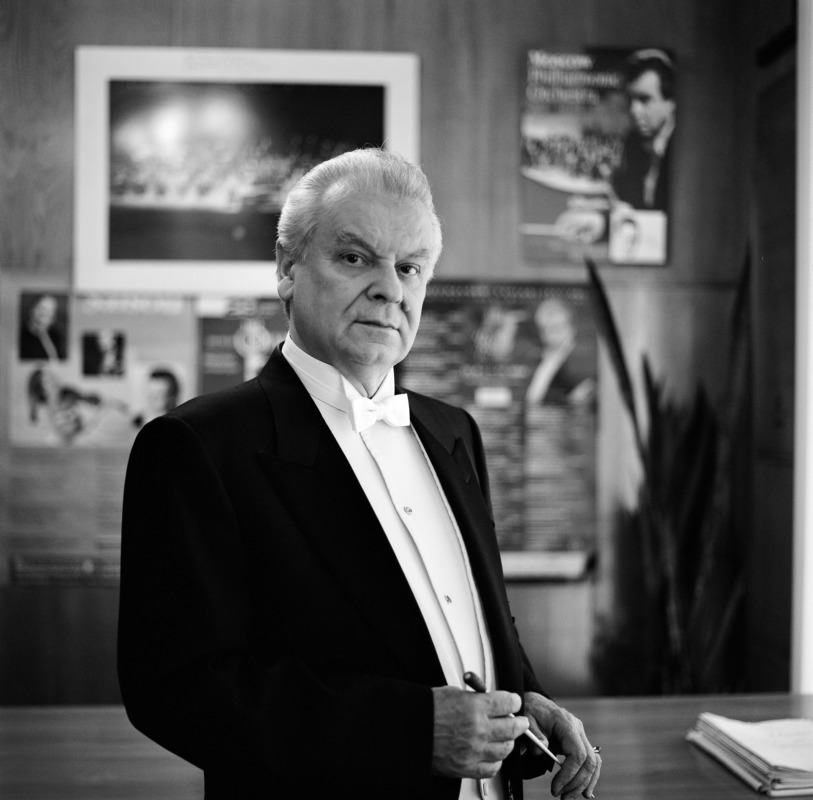 Simonov (pictured right by Ivan Smirnov), who at 76 has been chief conductor of the Moscow Philharmonic for the past 18 years, is something of a sacred relic: very much of the old school of Russian conductors, with every gesture clear and meaningful even if he's sometimes playing to the audience rather than to the orchestra. His Swan Lake excerpts would have been sclerotic were it not for the inner life of the lines. Odd to start with the ballet's Introduction rather than the famous "swan theme", especially as it doesn't cadence without the first number in the ballet proper; but this did at least give us a chance to hear legendary paintstripping trumpets at the climax. And the trumpet tune in the big waltz was blatantly to the fore at first, backgrounded by the violin counterpoint on the repeat (good question - which is really the main melody?)
The Moscow Philharmonic strings, too, have that time-honoured Russian weight and brilliance when they need it (though it's not always easy to gauge the results six rows back in a hall too small for this orchestra). And they engaged it in spades in the harrowing Largo which begins and dominates Shostakovich's Sixth Symphony. The woodwind, oboe at muscular full pelt honourably excepted, were not on the same level; we expect more subtlety from western players, especially in the painful solos at the heart of the movement. The scherzo and galop which follow in this oddest and most daring of structures showed up Simonov's chief defect: a lack of rhythmic tautness, a reluctance to let his orchestra fly. But when it needed to be bludgeoning, as in the circus routine from hell at the end of the symphony, the results were hair-raising as only a Russian performance knows how to manage it.
It was a bit of a shame to follow that with the first of the encores, the anodyne if effective Romance tune from the film music to The Gadfly, not for nothing a Classic FM favourite; Shostakovich would turn in his grave if he knew how ubiquitous it's become. But the acidity of the Polka from The Age of Gold is always welcome, its blatant extremes once again poster-paint brilliant.