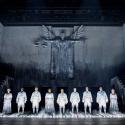
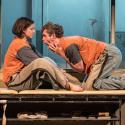
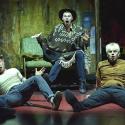
There may never have been a time when Shakespeare’s Richard III did not have contemporary relevance, but surely never more than it does right now. And it’s to the credit of director Mehmet Ergen that this production doesn’t go to town on it, but instead leaves the audience to make its own connections. From the start, Richard of York is shown to be a misogynist and a sociopath who is prepared to say anything, do anything to attain the seat of power. To borrow the words of a New Yorker profile of a certain presidential hopeful, his is “an existence unmolested by the rumbling of a soul”.
Greg Hicks is a very big talent to find treading the boards of an off-West End theatre, even one with such credentials as the Arcola, and the deep intelligence of his take on Richard comes as no surprise. Resisting any temptation to emulate the bullying charm, or even the smarm, of a familiar 21st century figure, Hicks’s Richard is a shrivelled prune of a man – or perhaps more a dried-up sloe, so bitterly cynical that (unlike Mark Rylance's Richard at The Globe five years ago) he cannot be bothered to feign a pleasant manner, even when he sets his cap at Lady Anne.
The jingling chain that tethers his left wrist to a lame foot gives him the air of a leper
Lanky and lean in skinny black jeans and a leather coat, this Richard has no hump to speak of and his deformity is hardly grotesque. Yet the jingling length of chain that tethers his lifeless left wrist to a lame foot gives him the air of a leper: we repeatedly hear him before we see him. And what we see chimes with the many references to him as a lowly dog.
What’s more, at those moments when Hicks shows us the whirring of Richard’s brain, apparently conceiving even as he utters the words to Queen Elizabeth the repellent idea of marrying her daughter (having just murdered her two young sons), he fingers the chain with nervy excitement, as if fiddling with his penis. It’s quite revolting.
Hicks does subtle things with his voice too, never quite settling on one accent – a touch of the East End mobster here, a touch of his native Leicester there; he often insultingly mimics the intonation of others, including his own mother. It’s a symptom of a human being so amoral that he no longer knows who he is.
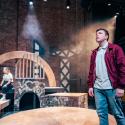
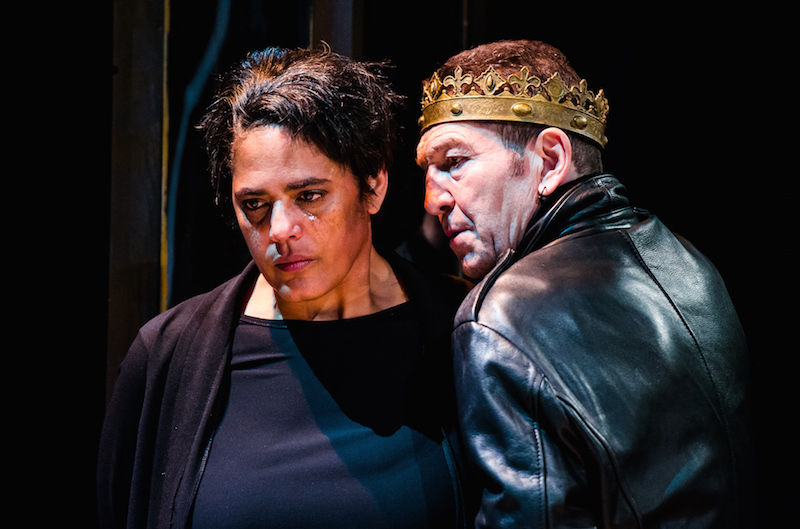 The supporting cast is a touch variable, though some contributions are strong. Among these Sara Powell (pictured above with Hicks) makes a fine job of Elizabeth, a role that can too easily be made unwatchable by grief, and Matthew Sim is a memorably chilling Catesby. Immaculately dressed and inscrutable behind Andy Warhol specs, he has an epicurean’s distaste for dirt and mess, handling the murderous folding penknife he keeps in his pocket as if it were a carefully pressed napkin. On top of all that, it was a nice idea to give him a coke habit.
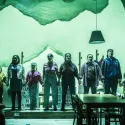
The smallness of the Arcola’s playing space – with the audience on three sides – restricts set design to the barest minimum. Nevertheless, designer Anthony Lamble manages to squeeze in a two-storey structure which serves well enough as the dreaded Tower and for the flying of battle standards. Yet beyond a hint of khaki and tent canvas, there is no attempt to suggest the scene on Bosworth Field. In the circumstances it seems entirely apt that this Richard’s demise should come about by means of his own dagger in his own hand, forced on him by Jamie de Courcey’s credibly devout Richmond.
This Richard III is perhaps too plain and sparse to be an ideal introduction either to the history plays or to Shakespeare’s work as a whole. Yet for the playing of its central character and the clarity of verse-speaking across the cast, it is commendable.