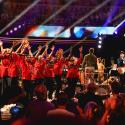
Well, it wasn’t exactly the most cheerful night of my life. Especially the first half. Peter Gabriel, musical polymath and father of such irresistibly rhythmic and uplifting songs as “Sledgehammer” and “Steam”, had decided that his new world tour would feature no guitars, no electric instruments, no drum kit; instead, there would be a full orchestra, a grand piano, a couple of backing singers, and himself. And you can’t fault him for trying something different: this was certainly a bold leap from the type of musical fare that’s normally served up in arenas such as the cavernous O2. But so grim! Especially the first half.
This was the section of the show that featured Gabriel’s new album, Scratch My Back, on which he and arranger John Metcalfe have radically re-imagined songs such as Paul Simon’s “The Boy in the Bubble” and Radiohead’s “Street Spirit (Fade Out)”. It’s ambitious, but Scratch My Back is in truth a hit-and-miss affair, sometimes beautiful but often turgid. The qualities, for instance, that make David Bowie’s “Heroes” so heroic – especially Brian Eno’s pulsing, swirling, looping riff – are entirely absent on Gabriel’s version.
Anyway, onstage, performed in its entirety, Scratch My Back was a largely downbeat affair, enlivened by some neat visuals on the multiple big screens and by the occasional bursting-into-life of the orchestra, notably on Elbow’s “Mirrorball” and Arcade Fire’s "My Body Is a Cage”. Gabriel’s voice sounded in remarkable shape given that he is now 60, and his pride in the project as a whole was palpable.
But the mood was overwhelmingly dark; the first and only time during this part of the show when I experienced that tell-tale prickly-scalp feeling came during Lou Reed’s “The Power of the Heart”. And it was surely a mistake to send the fans scurrying off to the bars before the interval with Gabriel’s version of “Street Spirit” ringing in their ears and darkening their souls; at least the original, while still a paragon of studenty miserabilism, reaches some kind of resolution with its final refrain of “Immerse yourself in love”, but Gabriel, dressed in baggy, baggy, dark, dark clothes, sounded as though he wanted us to immerse ourselves in a peat bog.
Part two, in which Gabriel delved into his back catalogue, was a big improvement. Part of me hoped that while we were off refreshing ourselves, the orchestra had been swept away and replaced by a full band with brass section. But no: Gabriel’s own songs, too, were being given the orchestral makeover treatment. Nevertheless, there was a new brightness and vibrancy in the air, a greater sense of purpose and urgency and belief. “San Jacinto” was stirring, “Digging in the Dirt” crackled with energy, while “Rhythm of the Heat” was – praise be! – actually rhythmic.
Even so, and despite Gabriel’s emotionally uninhibited singing, I remained largely unmoved. Partly I think this was because, although I truly adore the rich, full sound of a proper orchestra, I never feel quite the same about one that is amplified. This is no reflection on the sound system (excellent) or the O2 Arena’s acoustics (fine); it’s just that the amplification process seems to rob orchestras of their essential orchestra-ness. Chiefly, though, it was because so much of the music was just so downbeat.
Towards the end, finally, came uplift in the shape of “Solsbury Hill”: violins playing that unforgettable riff, fans clapping, and Peter Gabriel actually skipping across the stage. It was a bit late in the evening to decide to start having fun, but at least he showed that he still has it in him.