

When Ridley Scott returned to his hideous intergalactic monster with Prometheus five years ago, he brought with him a new panoramic vision encompassing infinite space, several millennia of time and the entire history of human existence. With Alien: Covenant, he makes a more modest proposal.
film reviews
Jasper Rees

To appreciate the full engaging silliness of Mindhorn, it helps to have been born no later than 1980. Those of the requisite vintage will have encountered the lame primetime pap it both salutes and satirises. Everyone else coming to this spoof will just have to take it on trust that things, admittedly not all of them British, were indeed this bad back in the day.
The eponymous detective of the adventure crime show wears a brown leather blouson, grey leather slip-ons and an eyepatch that allows him to see the truth. He’s a hot smoothie who hunts down bad guys alone, principally on the Isle of Man, with the help of a fast soft-top and some arthritic moves from the martial arts playbook. But that was the Eighties and now Richard Thorncroft, the actor who played him, is a balding tub of lard in a bedsit reduced to earning a crust endorsing surgical supports for the elderly. His agent has no work for him. He gets summoned to an audition to play a yardie as a result of a clerical error. Kenneth Branagh, one of several A listers recruited to play himself, is underwhelmed.
T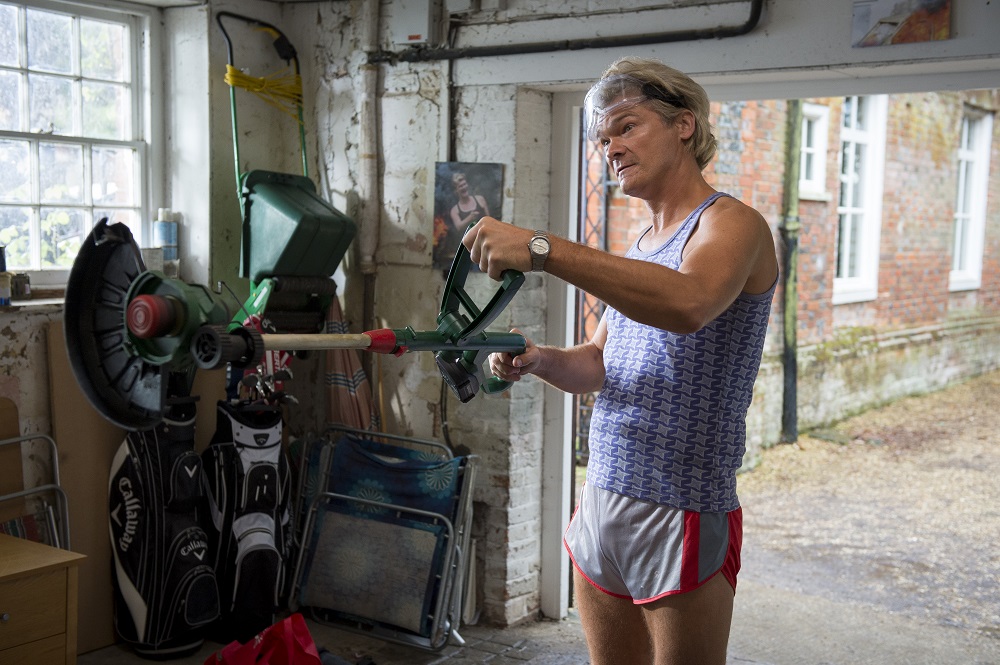 hen a murder is committed on Detective Mindhorn’s old stomping ground and there’s only one person the presumed culprit (Russell Tovey) will communicate with. Thorncroft imagines this is an opportunity that can put him back in the game. Cue a frantic caper which mimics precisely the kind of naff storylines Mindhorn got mixed up in all those decades ago.
The pleasure of this low-budget British comedy is very much centred on the charming, buffoonish performance of Julian Barratt, the funny one from The Mighty Boosh, as a washed-up old ham whose ego has somehow kept his estimation of himself intact. (See also Bill Nighy in Their Finest.) There is almost no delusion which doesn’t have Thorncroft in its grip. Chief among these is that his old lover and co-star Patricia Deville (Essie Davis) still has the hots for him. Humiliatingly she has married Thorncroft’s thinner Dutch stuntman Clive (played by Barrett’s co-scriptwriter Simon Farnaby, pictured above).
 Loitering on the fringes are Andrea Riseborough as a policewoman, Nicholas Farrell as a villainous civic leader, Richard McCabe as a hollowed-out cokehead in a caravan, and Steve Coogan (looking freakishly thin and ripped) as Thorncroft’s creepy old supporting player. Mindhorn is directed by Sean Foley, tacking across from stage comedy and bringing in pals like Branagh to lighten up and have a good time.
There are fun setpieces including a crap parade with a real shoot-out, plus some lovely lines too. Harriet Walter, ditching Thorncroft as her client, has a killer putdown which she administers over the phone: “I’ve left your headshots in reception.” It won’t win many awards or break many box office records, but Mindhorn doesn’t outstay its welcome and approaches the important business of spoofery with a practically academic attention to ridiculous detail. A hoot.
Overleaf: watch the trailer to Mindhorn
Saskia Baron

The original Guardians of the Galaxy from 2014 had a freshness to its humour and introduced audiences to a set of novel characters; unfortunately, the sequel is overstuffed with ageing movie stars trying to get a slice of the action. There’s always a camp knowingness about Marvel scripts, it's one of the studio's charms, but here the overt cynicism begins to drag with lines like "We’re really going to be able to jack up our price if we’re two-times galaxy saviours".
Foul-tempered Rocket the raccoon and two of the new characters are very welcome on screen – there's cute baby Groot who just wants to dance and Mantis (Pom Klementieff), a naive "Empath" who is adorned with antennae that sense everyone’s emotions. She makes an excellent comic foil for muscle man Drax (Dave Bautista) and definitely adds to the film's eclectic characters. But the old-time stars drafted in – Kurt Russell, Sylvester Stallone, David Hasselhoff – add little to this intergalactic party, other than queasiness watching their weirdly plasticky faces.
Crash cut to 34 years later on a planet far, far away...
Guardians of the Galaxy Vol 2 opens with one of those scenes where an older actor is recreated as their youthful self through the wonders of CGI – think Carrie Fisher in Rogue One: A Star War's Story. Here it’s Kurt Russell making the audience suffer the uncanny valley effect. He plays an out-of-town hunk with a flowing ‘70s hairdo, impregnating an innocent Missouri teenager in 1980. Crash cut to 34 years later on a planet far, far away, where Peter Quill (Chris Pratt) and his motley crew of Guardians are battling a giant squid with too many teeth while baby Groot boogies to ELO’s Mr Blue Sky – all this before the main titles.
The first movie was all about establishing the identities of these misfit space vagabonds, eavesdropping on their quarrelsome banter and enjoying their video-game inspired violence, set to a kitschy but infectious MOR soundtrack. But we know these characters now, and the sequel’s plot is bogged down in tedious family drama dynamics – Quill's quest for his mysterious dad (shades of Luke Skywalker/Darth Vader) and the rivalry between sisters Gamora (Zoe Saldana) and Nebula (Karen Gillan).
 The movie stop-starts between fight-chase sequences played out against pop tunes from Quill’s beloved mix-tape; there's something a little alienating about the repeated use of dissonance between the cheery songs ("Come a Little Bit Closer" by Jay & The Americans) and the slomo violence meted out by the Guardians. The disjunction continues with dialogue scenes that flit between gags about turds, Cheers and douchebags and soppy/profound stuff about the true nature of fatherhood and friendship.
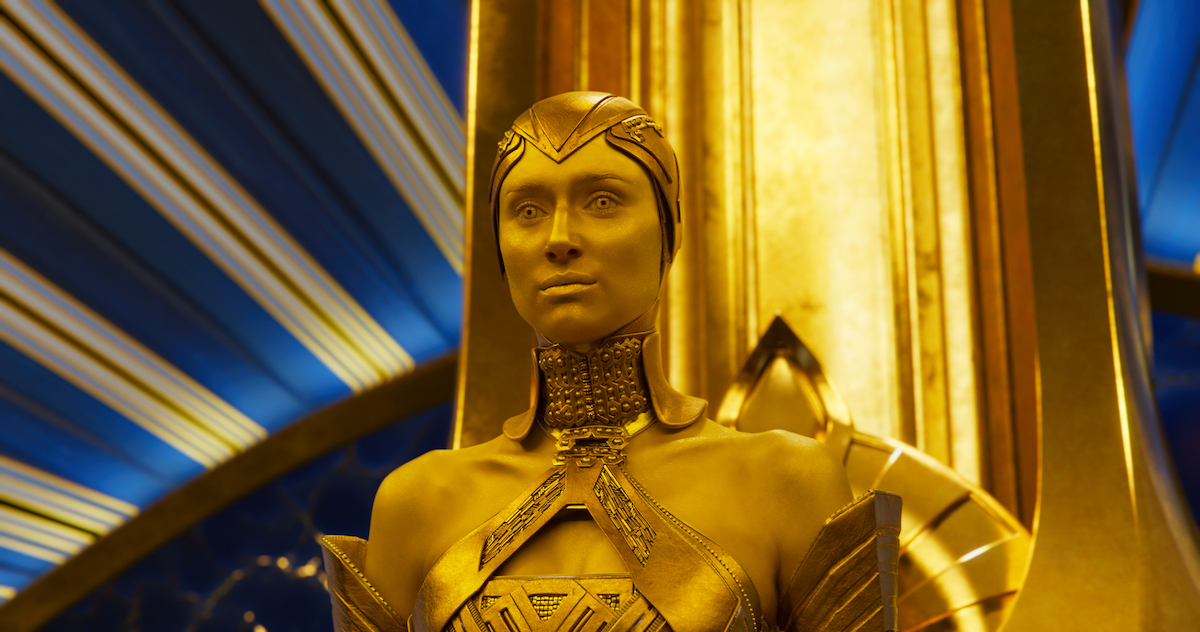
The art directors seem to have mined a mash-up of Roger Dean and Hipgnosis album covers for the overall look of the film, while the make-up artists' heavy-handed maquillage have rendered all but Pratt and Russell unrecognisable from their real-life selves. Elizabeth Debicki (pictured above), who exposed so much of her own skin in the designer dresses of The Night Manager, is completely coated in gold paint, while Michael Rooker’s Yondu is rendered Smurf blue with dodgy dentition and a detachable Mohican. His character, a quasi-father figure, gets more than his fair share of screen time. Fans will be rewarded with not one but two jokey cameos by Stan Lee and Howard the Duck; sitting through the end credits results in no less than five teaser trailers. It's hard though to warmly recommend the film to non-fans due to too many in-jokes and a general sense of complacency in script and direction. It’s simply not as much fun as the first film because it's a reprise rather than a reinvention.
Overleaf: watch the official trailer for Guardians of the Galaxy Vol 2
Adam Sweeting

The Armenian genocide by the Ottomans during and after World War One killed 1.5 million people and is a wound that won’t heal for Armenians, though modern-day Turkey continues to insist that no genocide occurred.

Markie Robson-Scott

Three teenage boys meet at dawn. One of them, blonde and beautiful Simon (Gabin Verdet), jumps out of his girlfriend’s window and rides his bike through the dark Lyon streets to meet the others in their van. They drive almost silently to the beach, put on wetsuits and catch waves. A grey sea, a grey sky: we can hardly see where foam ends and cloud begins. It’s mesmerising, wordless, and the camerawork is superb, as is Alexandre Desplat’s score. We’re inside the curl of the wave, as immersed in it as Simon. Then the surfer dudes are back in the van, exhausted, on the road home.
Demetrios Matheou

Within seconds – literally seconds – of Unforgettable it becomes apparent that this is the kind of film that in the late Eighties and Nineties used to be referred to as “straight to video”, a label that covered a plethora of trashy, sexist, by-the-numbers psycho and erotic thrillers that beat a hasty route to Blockbuster. To actually see one in the cinema, released by a major studio, is a disconcerting experience.
Adam Sweeting

An Egyptian/French co-production directed by Egyptian film-maker Mohamed Diab, Clash is a fevered, chaotic attempt to portray some of the tangled undercurrents that fuelled Egypt’s “Arab Spring” and its subsequent unravelling.
Saskia Baron

Yet another excuse to snuggle down with some cosy wartime nostalgia, Their Finest is purportedly a tribute to women’s undervalued role in the British film industry. Unfortunately it comes over more blah than Blitz.
Nick Hasted

Park Chan-wook is a Korean decadent and moralist who’d have plenty to say to Aubrey Beardsley.