

Young Bulgarian writer-directors Kristina Grozeva and Petar Valchanov have made a tight, bleak, suspenseful drama in The Lesson (Urok), driven by a commanding, unforgiving performance from actress Margita Gosheva who leads the film. Clearly made on a tight budget (though that doesn’t intrude on production values), their first feature tells an often remorseless story of what happens when the money runs out, which replays themes familiar from the Balkans while also attaining an almost existential dimension.
film reviews
Adam Sweeting

We can keep blaming Frank Capra for the lingering notion that Yuletide has magical powers which can turn Scrooges into yo-ho-hoing Santas and convert blood-spattered family feuds into tearful hug-ins by a roaring log fire. To prove it, this would-be seasonal sackful of joy from director Jessie Nelson doesn't shrink from quoting It's a Wonderful Life, both visually and verbally. It's more like an SOS than a homage, though.
Marina Vaizey

"Exhibition on Screen" is a logical extension of the recent phenomenon of screenings of live performances of opera and theatre. Initiated with the Leonardo exhibition of 2012 at London’s National Gallery, this is its third season, and the format remains unchanged: a specific show provides the pretext for a bespoke film that goes beyond the gallery walls.
Jasper Rees

Nostalgia for the good old days of mutually assured destruction? You’d have got long odds on such a thing on 9 November 1989, the day the Berlin Wall was breached. A quarter of a century on, the Americans and the Russians are entangled in a whole other theatre of war in which the idea of negotiating with the enemy is unthinkable. The Soviets may have been abominable commie bastards but, hey, our guys could still clink a glass with them. So Steven Spielberg is able to visit the Cold War in something like a spirit of levity.
Bridge of Spies is much more overtly an entertainment than Schindler’s List and Saving Private Ryan. It’s also an unapologetic defence of American exceptionalism, as embodied in Tom Hanks, an actor who has inherited Jimmy Stewart’s ability to project intelligence matched by integrity. He plays James B. Donovan, a wily insurance lawyer who once upon a time was a prosecutor at Nuremberg. When a Soviet spy called Rudolf Abel (Mark Rylance) is hunted down in Brooklyn, he must be given an American version of a show trial: one in which the wheels of justice are seen to turn, and the accused is given a proper defence. Step forward, Donovan, reluctantly anticipating opprobrium and trouble for his suburban nuclear family of three kids and delectable wife (Amy Ryan, pictured below).
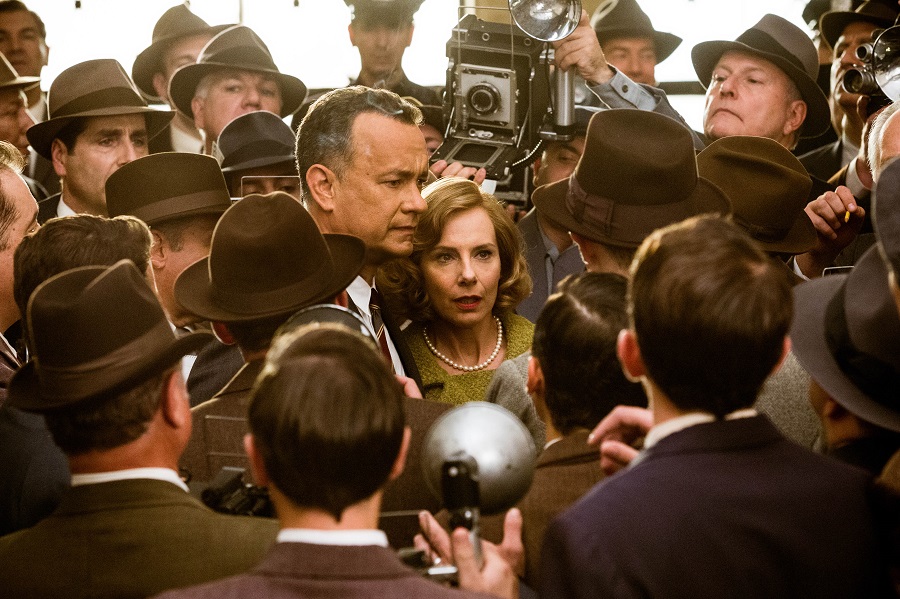 The complication is the CIA and the legislature don’t want Abel to get off the hook. Donovan's instinct, over which he has no control, is to give them a working lesson in the meaning of the constitution (see clip overleaf). Even Abel warns Donovan to go carefully. His advocacy works up to a point. Abel is spared execution, Donovan pleading that he may be useful as a bargaining chip when America wants to retrieve one of her own. Sure enough, a pilot on a top-secret high-altitude mission over Soviet space is promptly shot down in his U2 spy plane and fails to inject himself with poison to avoid falling into enemy hands. Donovan is sent to Berlin as a private individual to negotiate an exchange. Donovan being Donovan, and Spielberg enjoying a tilt against the odds, he tries to get two for one: the pilot, plus an American student caught on the wrong side the day the wall was erected.
This spin down memory lane, a great deal of it more or less based on fact, is the brainchild of Matt Charman, promoted to nosebleed territory from writing scripts for British television about family zoos and police skulduggery. He shares his credit with Joel and Ethan Coen and between them they have cooked up an intensely gripping thriller. The Coens, you suspect, were responsible for tugging the geopolitical face-off towards gentle caricature. The senior KGB encountered on the front line in East Berlin are saturnine but robustly comic, while much fun is had twitting the frustrated pawns representing the DDR. The boot is on the other foot for Sebastian Koch, more spied upon than spying in The Lives of Others but here playing East German lawyer Wolfgang Vogel.
 As for the look of the film, America is all polished wood and purring motors, while the spirit of Deighton and Le Carré is invoked in the grim greyness of Berlin on both sides (until we penetrate the Soviets’ plush embassy, that is). Spielberg does what only he can with a camera. He zooms shamelessly in to flag up psychological dilemma. For the moment the spy plane crashes, the clatter of plunging metal evokes that coach dangling over a cliff in Jurassic Park. The denouement is second only to ET for outright emotionalism. If the film has a flaw, it’s that the stories of the two captured Americans go for next to nothing, especially that of Francis Gary Powers, the pilot who was widely condemned for allowing himself to be captured.
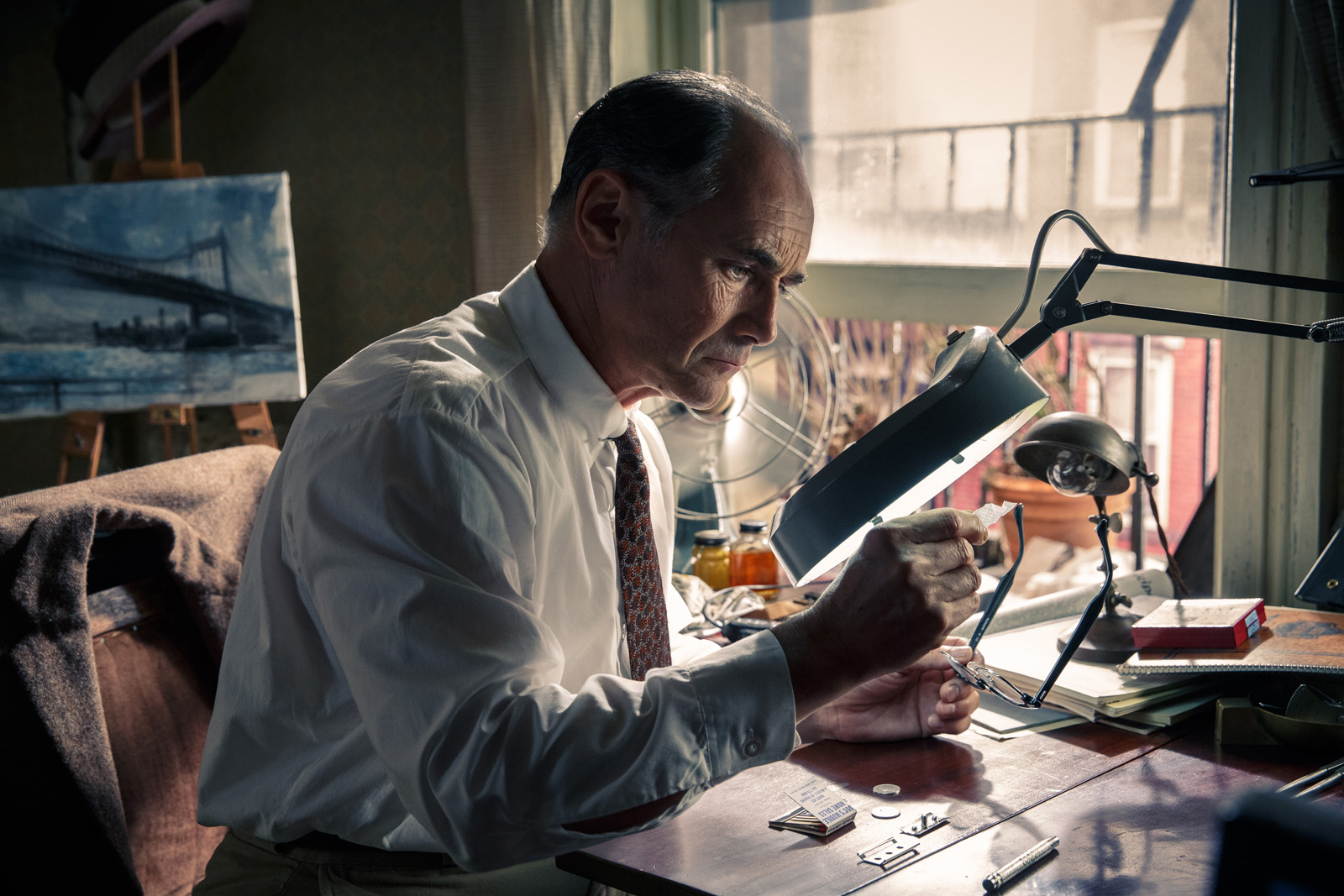
The film’s headlining novelty is Mark Rylance, who plays Abel with a vaguely Scottish accent as a poker-faced innocent with quite as much time to think and stare as Thomas Cromwell. He even gets a catchphrase. “Would it help?” he asks when Donovan wonders why he doesn’t look worried (see clip overleaf). Like the early scene in which he extracts a secret message from a tiny contraption (pictured above), the performance is mesmerising in its pernickety attention to detail. His scenes with Hanks are the riveting heart of this compelling - if not always plausible - comic-book history lesson.
Bridge of Spies really is the spy game as just that: a game whose horrors Spielberg has thrillingly sanitised.
MARK RYLANCE’S BIGGEST HITS ON STAGE AND SCREEN
Bridge of Spies. Spielberg's warm-hearted Cold War thriller is lit up by Tom Hanks and Mark Rylance
Endgame. In Complicite's homage to Beckett, Rylance's Hamm is an animated, self-lacerating lout
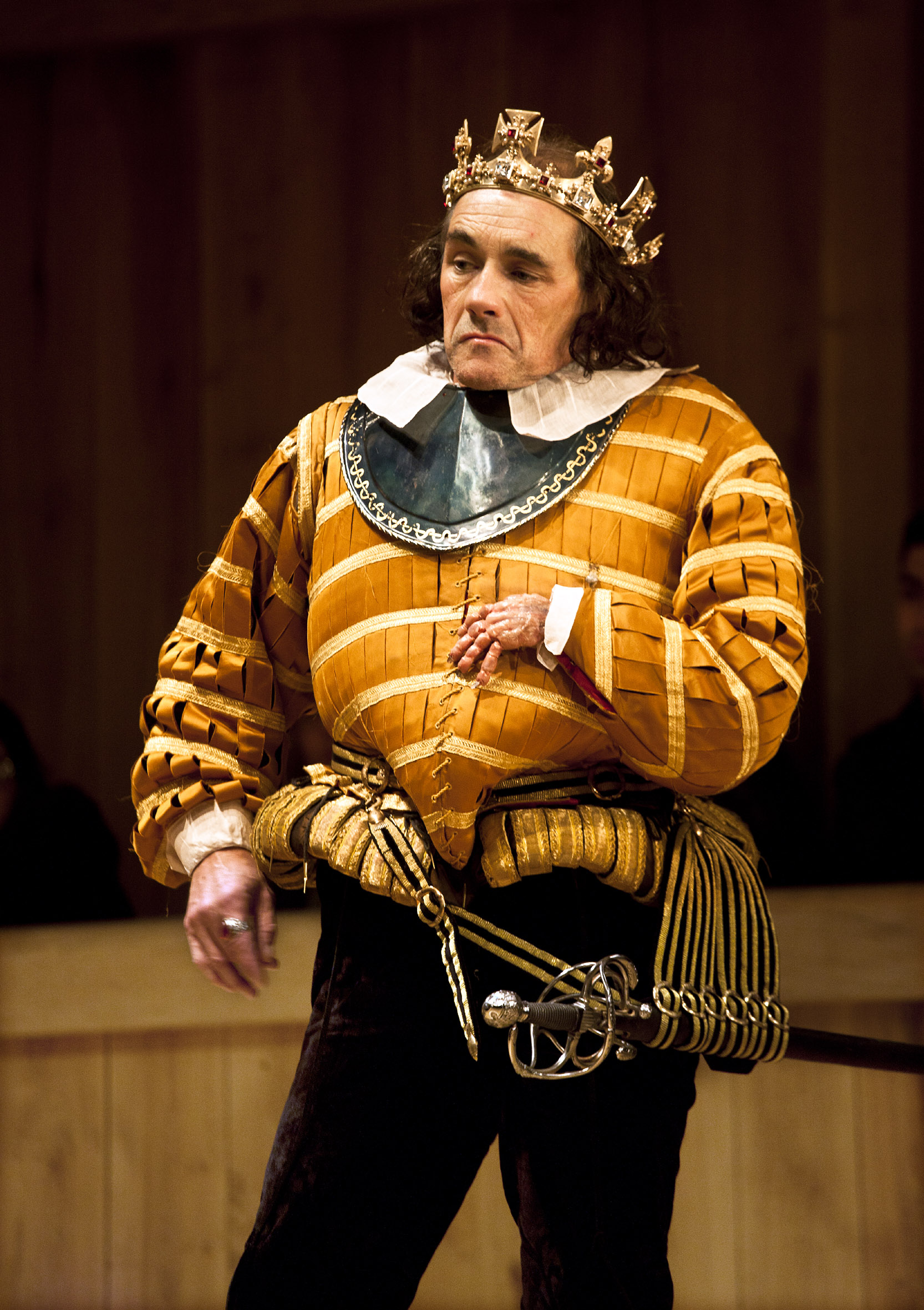 Farinelli and the King. A witty and moving new play is a timely reminder of just why art matters
Jerusalem. Rylance is unforgettable as Johnny Rooster Byron in Jez Butterworth’s smash Royal Court hit
The BFG. Rylance lends moments of the sublime to standard issue Spielberg
La Bête. Rylance dazzles in astonishing opening monologue, but this callow play coasts on the performances
Nice Fish. Rylance is waiting for cod-ot in this absurdist West End trifle
Twelfth Night/Richard III. Rylance doubles up as Olivia and the hunchbacked king for Shakespeare's Globe
Wolf Hall. Rylance works rare marvels as Hilary Mantel's scheming Tudor fixer
PLUS ONE TURKEY
Much Ado About Nothing. Rylance's Old Vic staging of Shakespeare's romantic comedy with elderly leads gets lost in translation
TO THE RESCUE: TOM HANKS SAVES THE WORLD (AND SOME IFFY MOVIES)
A Hologram for the King. Tom Hanks is the reason to see Dave Eggers's sentimental Saudi comedy
Captain Phillips. Piracy drama prompts bravura all-action display from director Paul Greengrass and captain Hanks
Cloud Atlas. Star company assumes various guises as David Mitchell's time-travelling masterpiece is lovingly told in under three hours
Extremely Loud and Incredibly Close. Oscar-nominated adaptation of Jonathan Safran Foer's novel is lacking in magic
Saving Mr Banks. Emma Thompson as PL Travers and Tom Hanks as Walt Disney track the journey of Mary Poppins from page to screen
Sully: Miracle On The Hudson. Eastwood and Hanks are the right men for an epic of understated heroism
Toy Story 3. To infinity and no further: Woody and the gang (sob) go on their final mission
PLUS ONE TURKEY
Inferno. In Dan Brown's dumbed-down Florence, Tom Hanks saves the world. But not the movie
Adam Sweeting

The city of Boston has been creeping up the charts as a hotbed of cinematic criminality in the last decade. First came Martin Scorsese's Oscar-scooping epic The Departed, then Ben Affleck chipped in with The Town, both movies driven by their portrayal of tightly-knit groups of characters immovably rooted in their native Bostonian soil.
Demetrios Matheou

New York, in the early 1950s. Twenty-something Therese Belivet is working in a Manhattan department store at Christmas, wearing a Santa hat and dutifully trying to overcome her boredom. Then Carol Aird strides into view – classy, confident, patrician Carol, archly eyeing the shop girl and nonchalantly buying the most expensive toy on offer, before leaving her gloves on the counter behind her. Therese’s life is about to change dramatically.
David Kettle

First-time writer/director Sanna Lenken’s touching anorexia drama is such a heartfelt, fragile thing that it feels churlish to criticise it. Herself a former eating-disorder sufferer, Lenken brings a real warmth and sincerity to her portrait of an ordinary Swedish family rapidly unravelling when their elder daughter seems unable to overcome the horrible physical effects of her aching self-doubt.
Matt Wolf

What begins as a would-be exercise in camp devolves into perfervid tosh and ultimately tedium in The Dressmaker, a belligerently over-the-top revenge drama that might just about have squeaked by as an opera - an art form better-suited to such deliberately over-the-top theatrics.
Tom Birchenough

Mexico City itself is the dominant presence in Alonso Ruizpalacios’ debut feature Güeros, a road movie that restricts its journey to that megapolis and its environs. It’s not just the traffic that holds them up, more the fact that they don’t really have a destination. As one of its initially dispirited student protagonists says, “Why go if we’re going to end up back here again?”
Adam Sweeting

By the end of the 1960s, Steve McQueen was at the top of the Hollywood heap. Star turns in The Great Escape, The Thomas Crown Affair and Bullitt had established him as the King of Cool, a self-contained anti-hero whose minimalist, watchful performances radiated a mysterious sex appeal.